Patmos, My Papouli’s Home
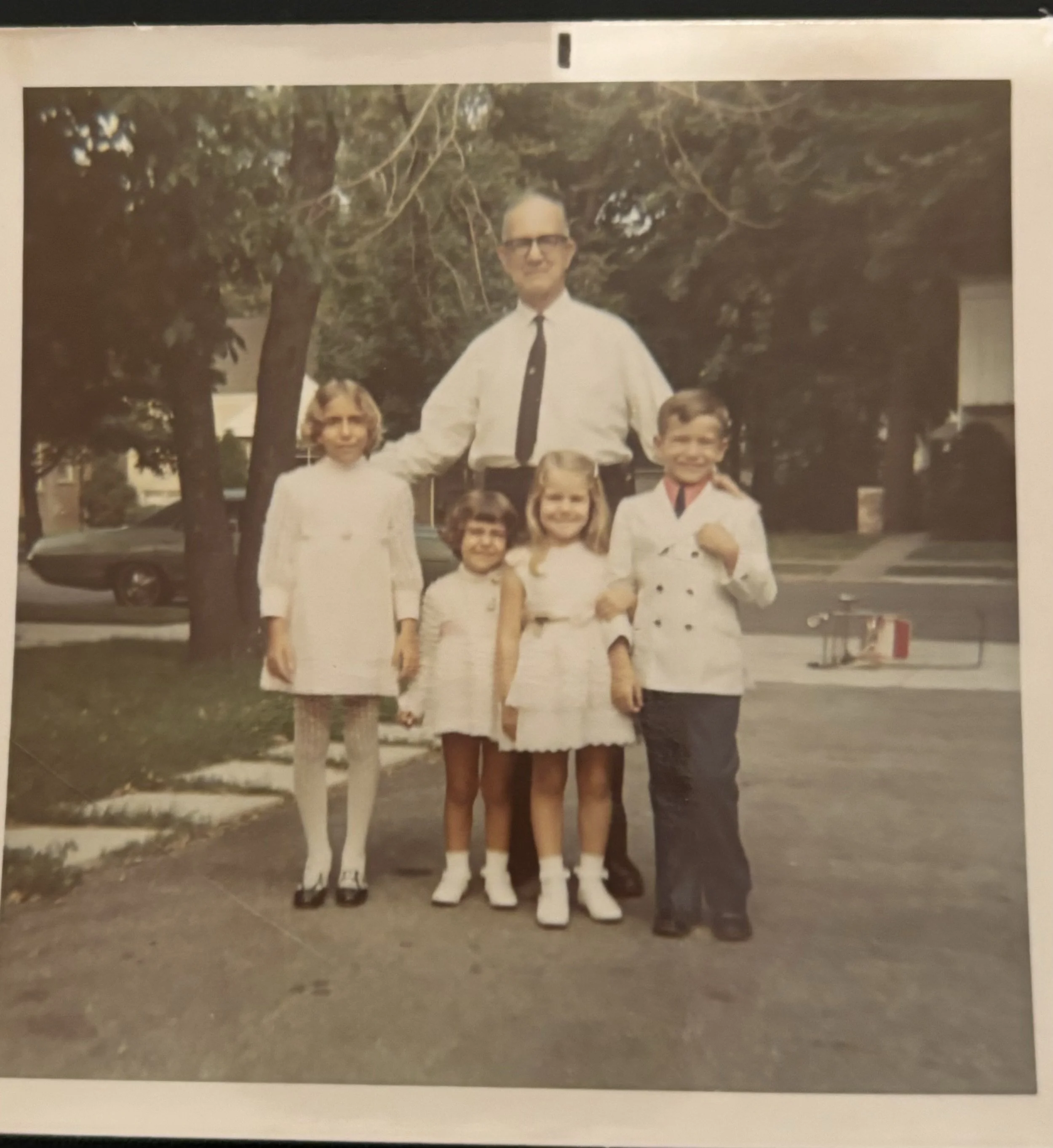
My Papouli, John Angelo Dorizas, with the first four of his grandchildren: Christine (Prekezes) Vranas, Irene "Cookie" Prekezas, Irene "Reni" (Dorizas) Bumpas, and John Prekezes. This photo was taken in front of my Aunt Calliope's home in Skokie, IL, on Kedvale Ave. when my brother Jad (John Angelo Dorizas) was baptized.
My Papouli, John Angelo Dorizas
Most Greeks call their grandfathers Papou. In our family, we say Papouli, which is a little like the difference between Granddad and Grandaddy.
We say Papouli because he is so dear to us. Is, not was, even though he passed from this world to the next in 1982.
My Papouli was John Angelo Dorizas, born June 20, 1899, in Ismailia, Egypt, because at the time his father, Angelo “Angeli” (Pronounced with a hard g like Greek) John Dorizas, was a pilot on the Suez Canal.
Prior to that, Papouli’s father had been a sea captain for the French Merchant Marines, sailing as far as Buenes Aires, Argentina.
The story passed down to me by my dad through Papouli is that his father, Angeli, spoke French for so many years, that he almost forgot how to speak Greek.
Papouli told Dad of sailing with his father as a little boy back and forth from Egypt to Patmos. When Angeli retired from the French company, they paid him in bags of gold and gave him a monthly pension of thirty Spanish gold doubloons each month.
Papouli had two younger sisters, Mosha and Hariklia. (Pronounced Môska and Ha-řee-klee-ah)
Because of the Greek dowry system, all the wealth would go to his daughters, which is why my papouli left Patmos at fourteen years old by joining the French Merchant Marines.
The home Papouli grew up in passed down to his sister Mosha, who married Vasili Moundreas, who was in shipping, and is now owned by Mosha’s granddaughter, Melina Moundreas Horne and her husband Dimitri Horne.
Prior to this trip, I had never met either of them. In 2011, the last time I visited Patmos, Melina had just left, and Calliope remarked how she wished we could have seen the home. In 2011, I only got to see it from the outside, but passed by regularly as it is right by the bakery in Hora.
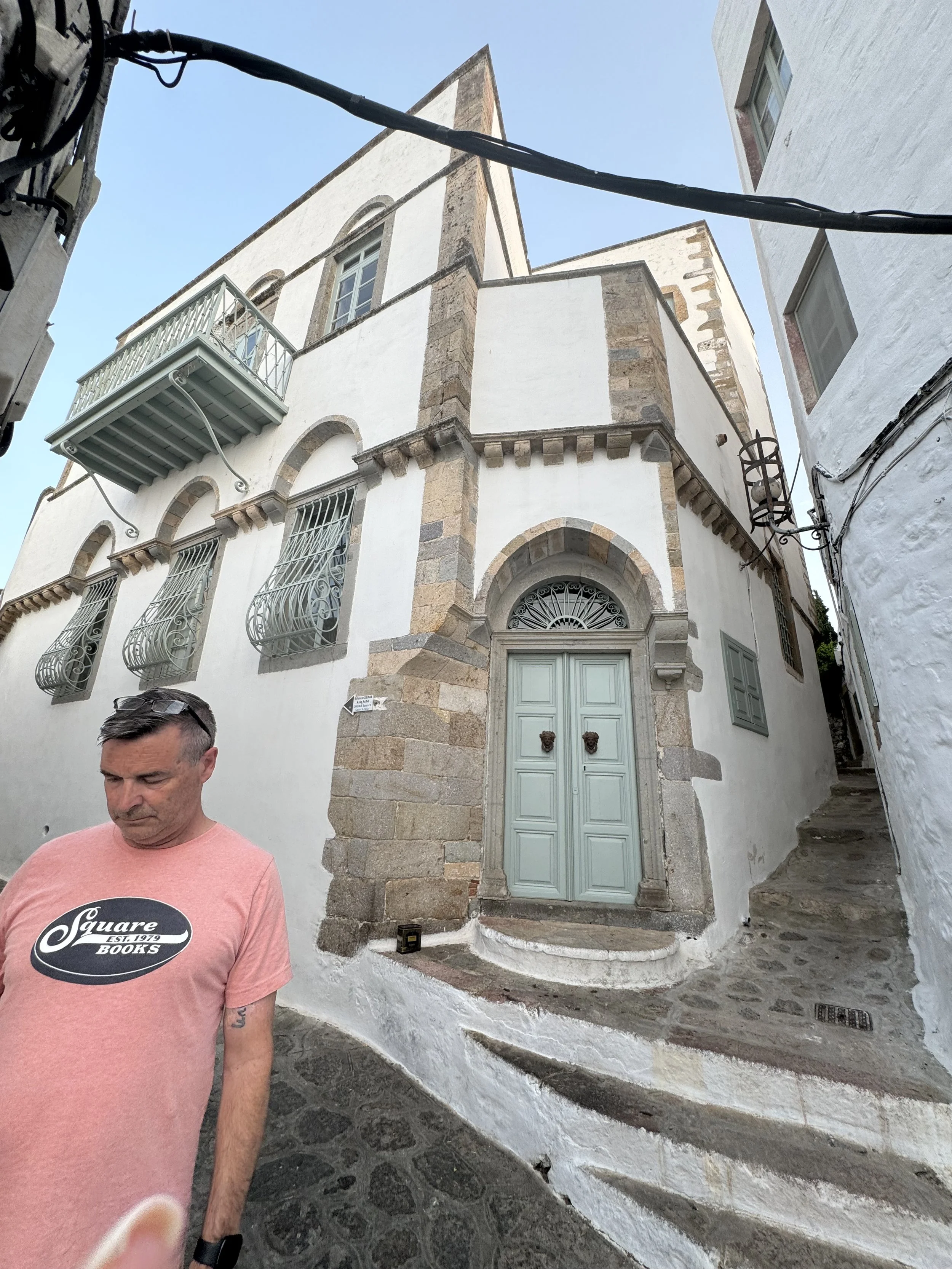
The home Papouli grew up in takes up an entire corner, so the doors near the bakery are actually the back doors. Turn left, walk down the alley beneath the balcony of their home on the right, and when you turn again, you face their front door.
As you go down the cobblestone walkway, you notice a balcony overhead. Cookie explained that before Melina and Dimitri acquired the house, in 2001, the balcony was about to fall off onto the ground into the street. Someone pulled it into the house. Melina explained, “We’re so fortunate that someone brought the balcony in and that we were able to put it back in its original place.”
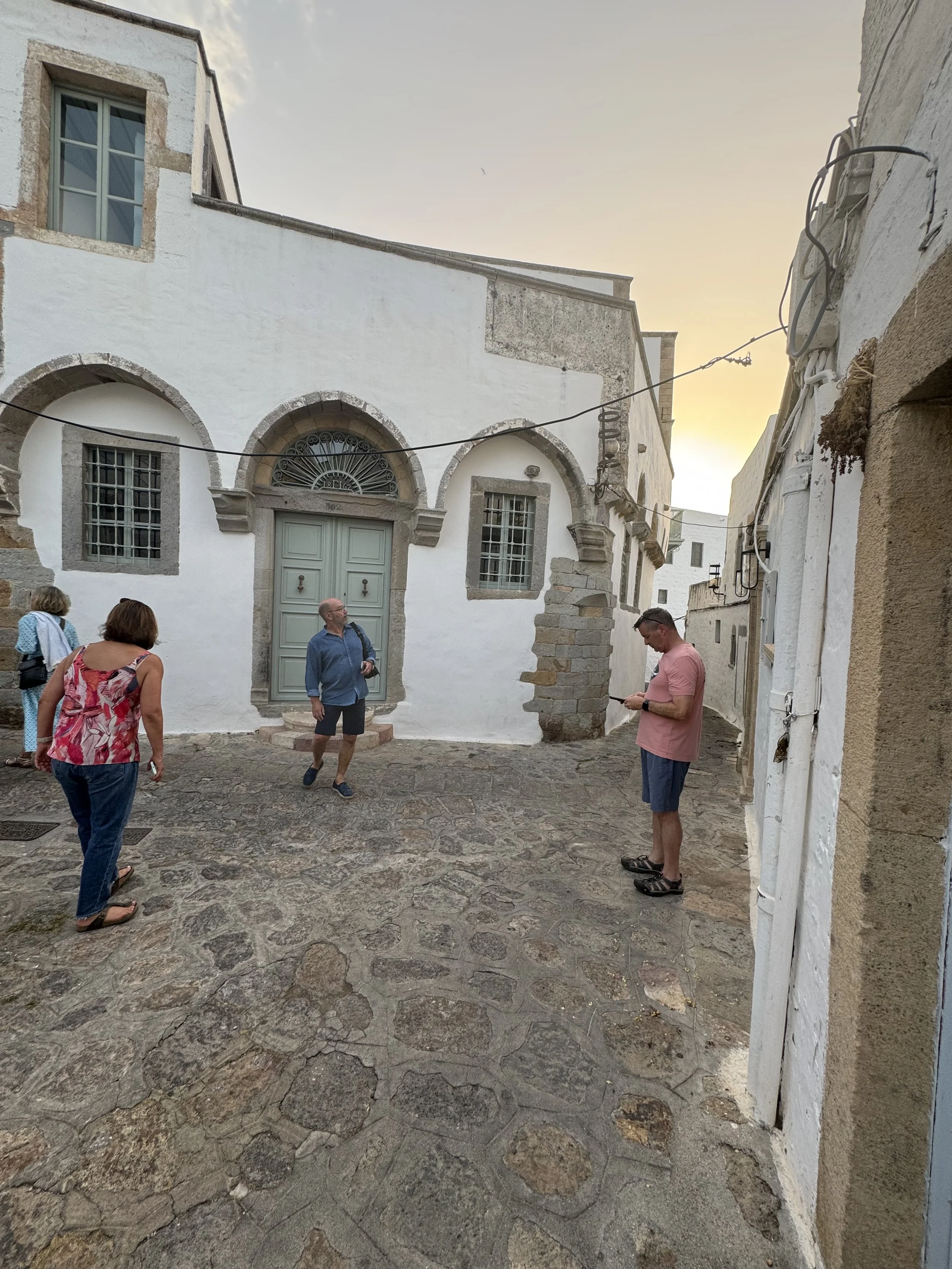
The balcony is almost directly above Wally's head in this picture, though actually, as you can tell, it is down the alley a bit--the entire block on the left is the home Papouli grew up in.
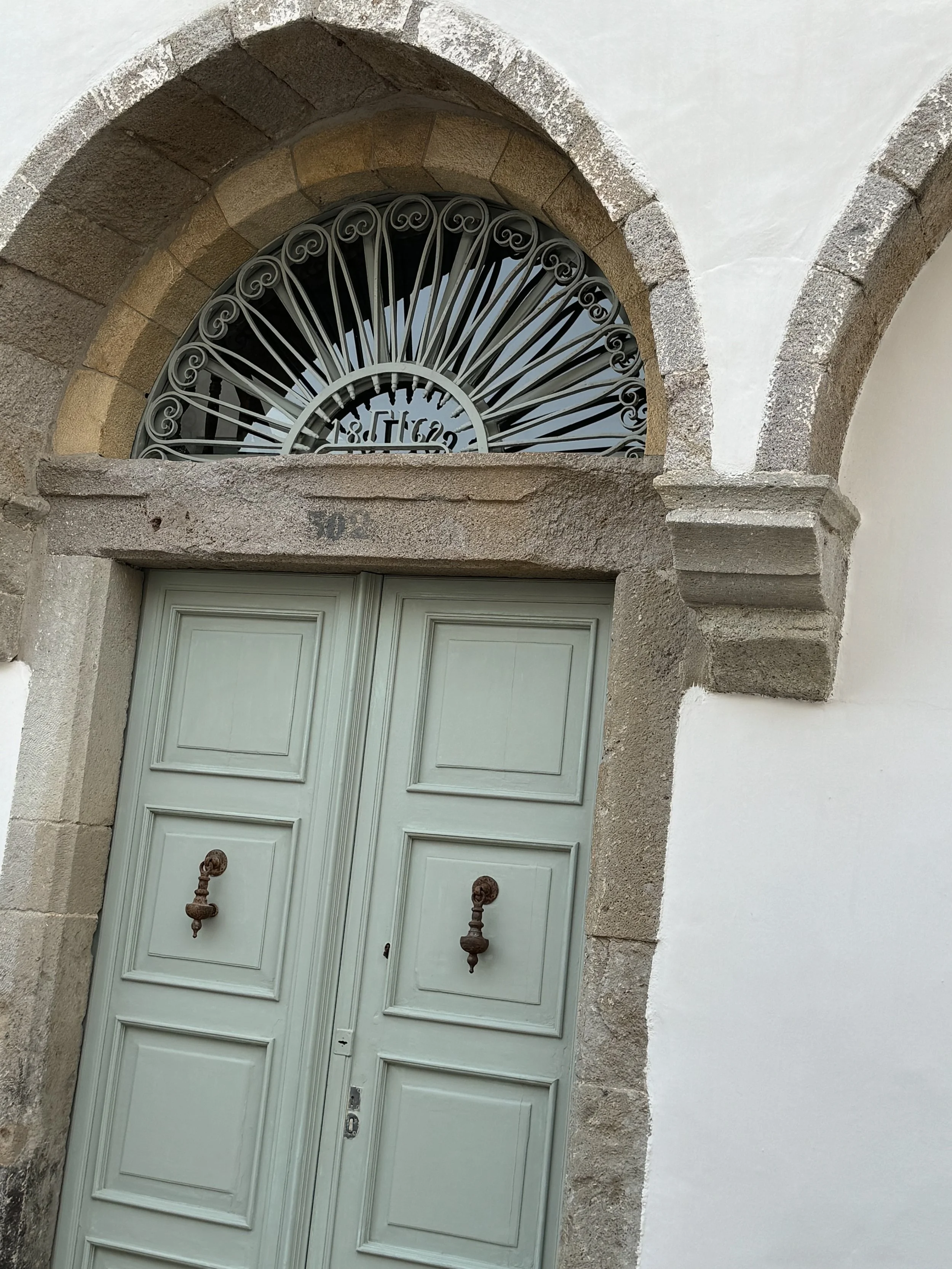
If you zoom in above the front door, you will see ΓΙ (the Greek letters Gamma and Iota), slightly larger and in the middle of the year 1862.
The question Cookie and I had was whose initials were ΓΙ?
The Home of YiaYia Calliope Alexakis – Now Home of Aga Khan
When I visited in 1985, I went with Aunt Calliope to visit the home of someone in Papouli’s family. It may have been Papouli’s home or some other grandparent. But I doubt I visited the home of Papouli’s mother, Calliope Alexakis (Dorizas) which is now owned by Aga Khan, because Aunt Calliope would have surely mentioned that to Cookie. I have been so puzzled about whose home I visited if not Papouli’s or his mother’s.
Evidently, Cookie has been puzzled too. After we got home, she told me jet lag woke her at 4:00AM and it occurred to her that it may have been Thea (Aunt) Angelikie’s, who was Yaya’s sister-in-law—married to her brother, George.
But fascinating is an understatement to think that Aga Khan’s Patmos home was once my great grandmother’s. An internet search for Aga Khan and Patmos led me to this NYTimes article.
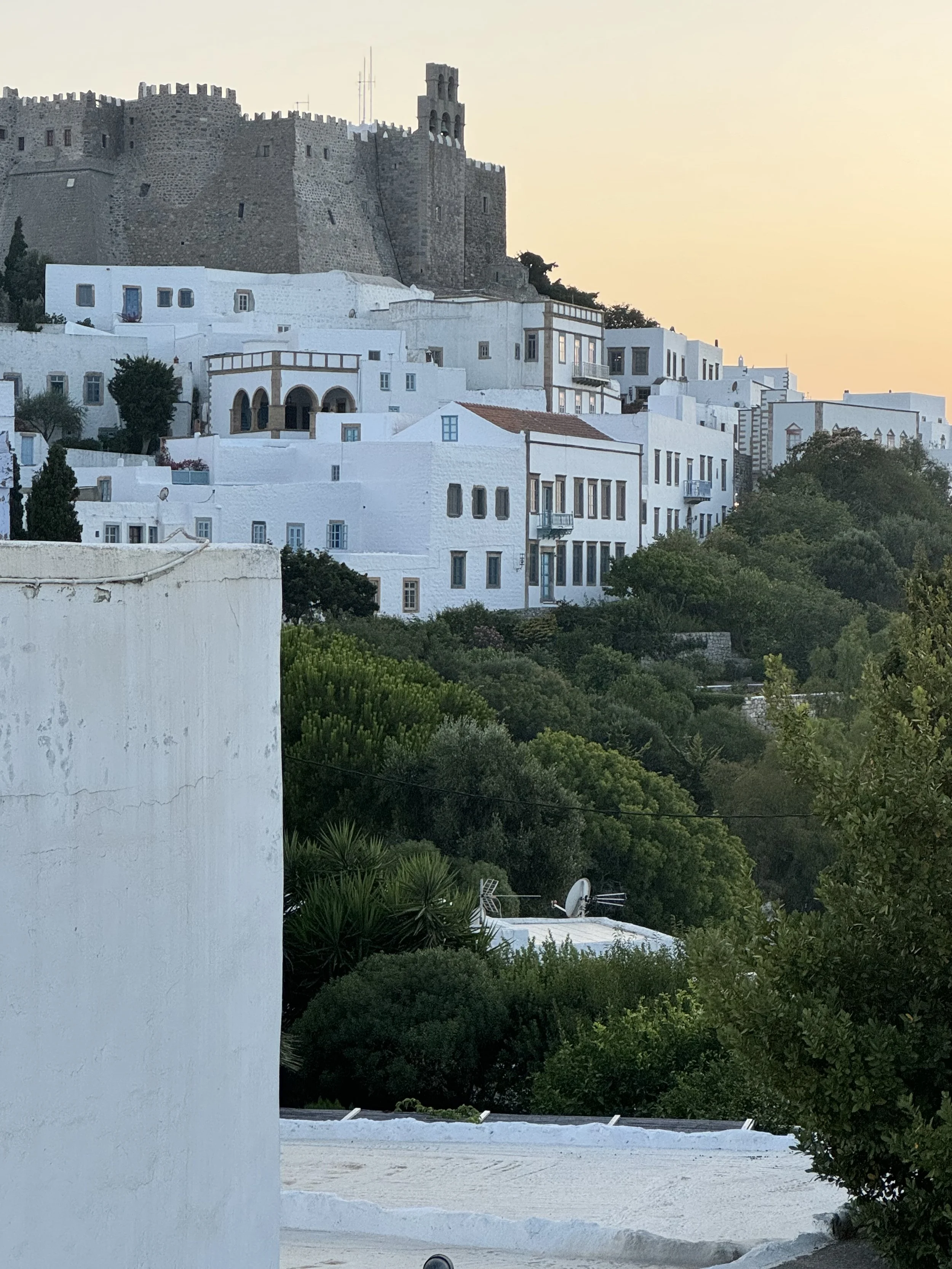
One evening as we watched the sunset, Cookie pointed out the home from the outside. It’s the two story home with the slanted colored roof. Melina brought out that the wealthy merchants built their homes to face the village of Skala so they could see the ships as they came in.
The standout memory I have from the grandparents’ house I visited in 1985 is a very dark home with ceilings that were perhaps 20′ high — higher than any I had seen before–and massive original paintings from the Italian Renaissance that hung from heavy chains at an angle so that the tops of the frames hung one or two feet away from the wall, and the bottoms of the frames touched the walls–just above the door frames. My aunt explained they hung them that way so they could be seen because they were so high.
As a twenty year-old, I had some appreciation for what I was seeing. But not like I have now. I’ve wanted to go back ever since. I remember thinking at the time that if people knew those paintings were there, they probably would want them in a museum.
So, whether I visited Papouli’s house or another grandparent’s, I was so very thankful that Melina’s husband Dimitri was at their home in Patmos with their daughter Annabelle, who just graduated from high school. Unfortunately, Melina had to stay in London because of work, but Cookie and I talked to her on the phone a couple of times after we visited her home.
Cookie had been in touch with them, and we happened to run into Dimitri and Annabelle at the beach our first day, so he invited us to come by to see the house. He was incredibly hospitable, kind, and informative.
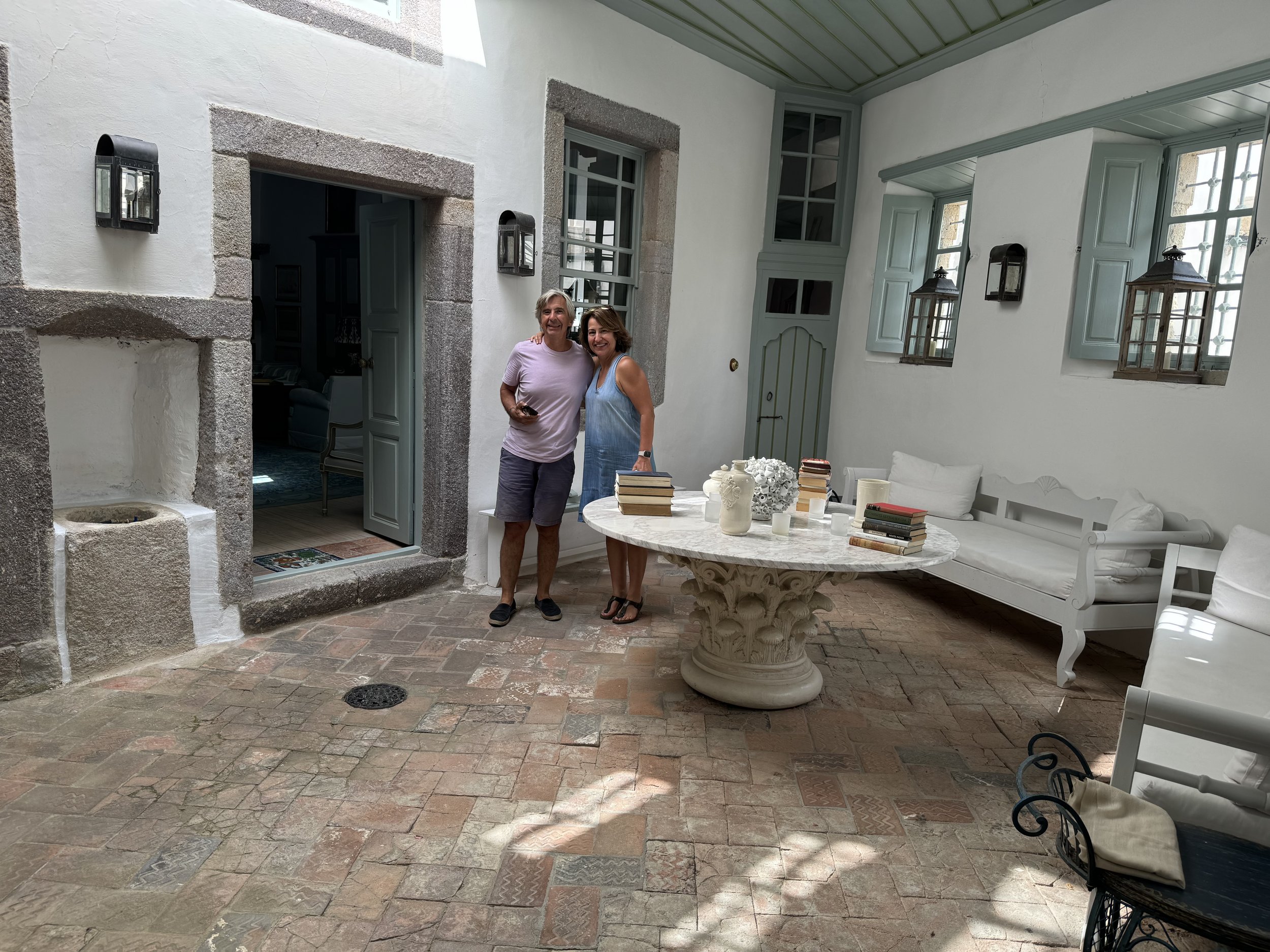
When we walked in the door, Dimitri began telling us the care that he and Melina took to preserve as much of the original home as they could. In a phone conversation, Melina explained that it took her and Dimitri seven years to make the house livable, from 2001-2008.
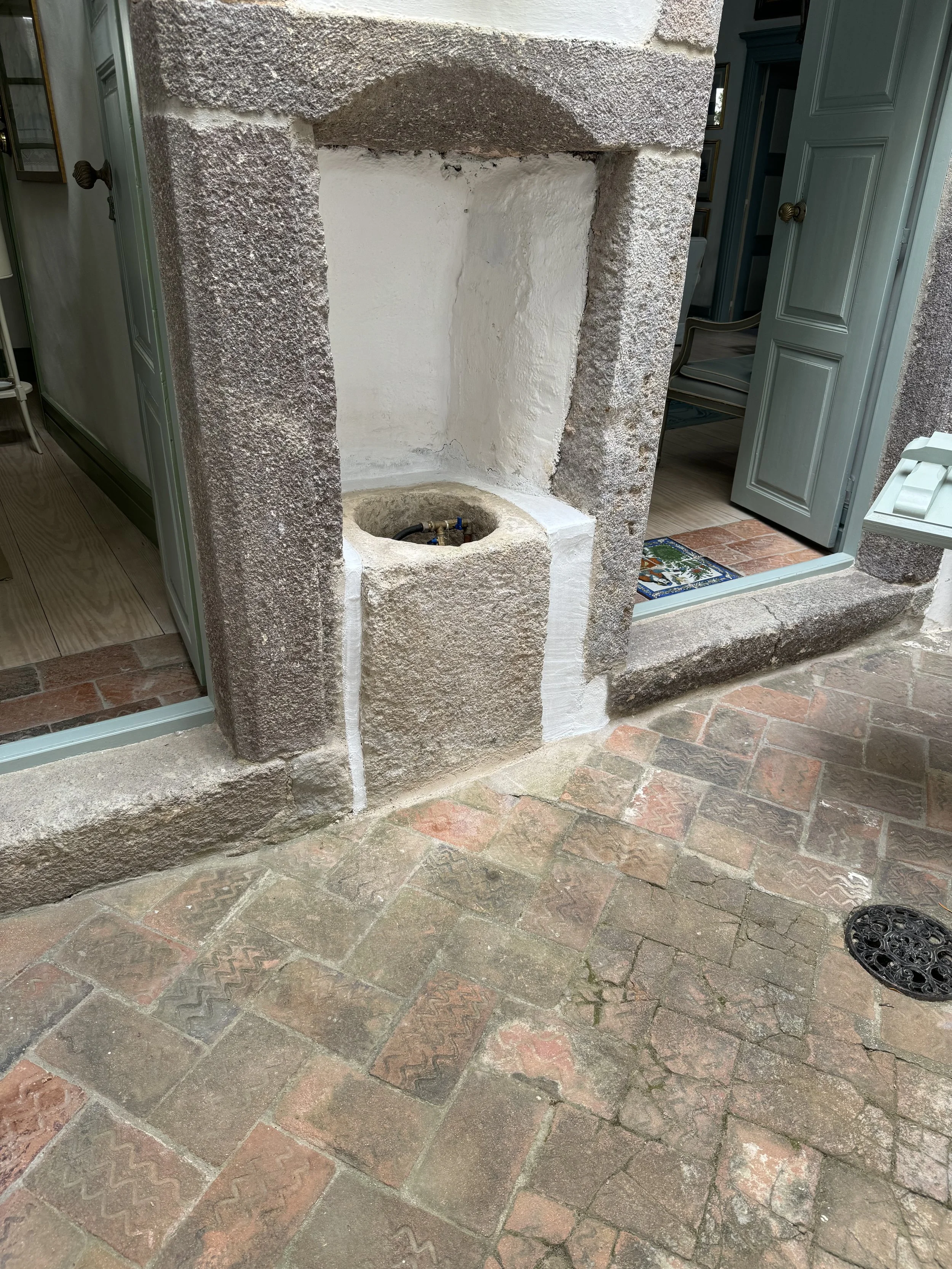
He pointed out how the floors were original, and he removed the lid from the well, (pictured between the two doorways) explaining how their neighbors back then from around the village would have come to them to get fresh water.
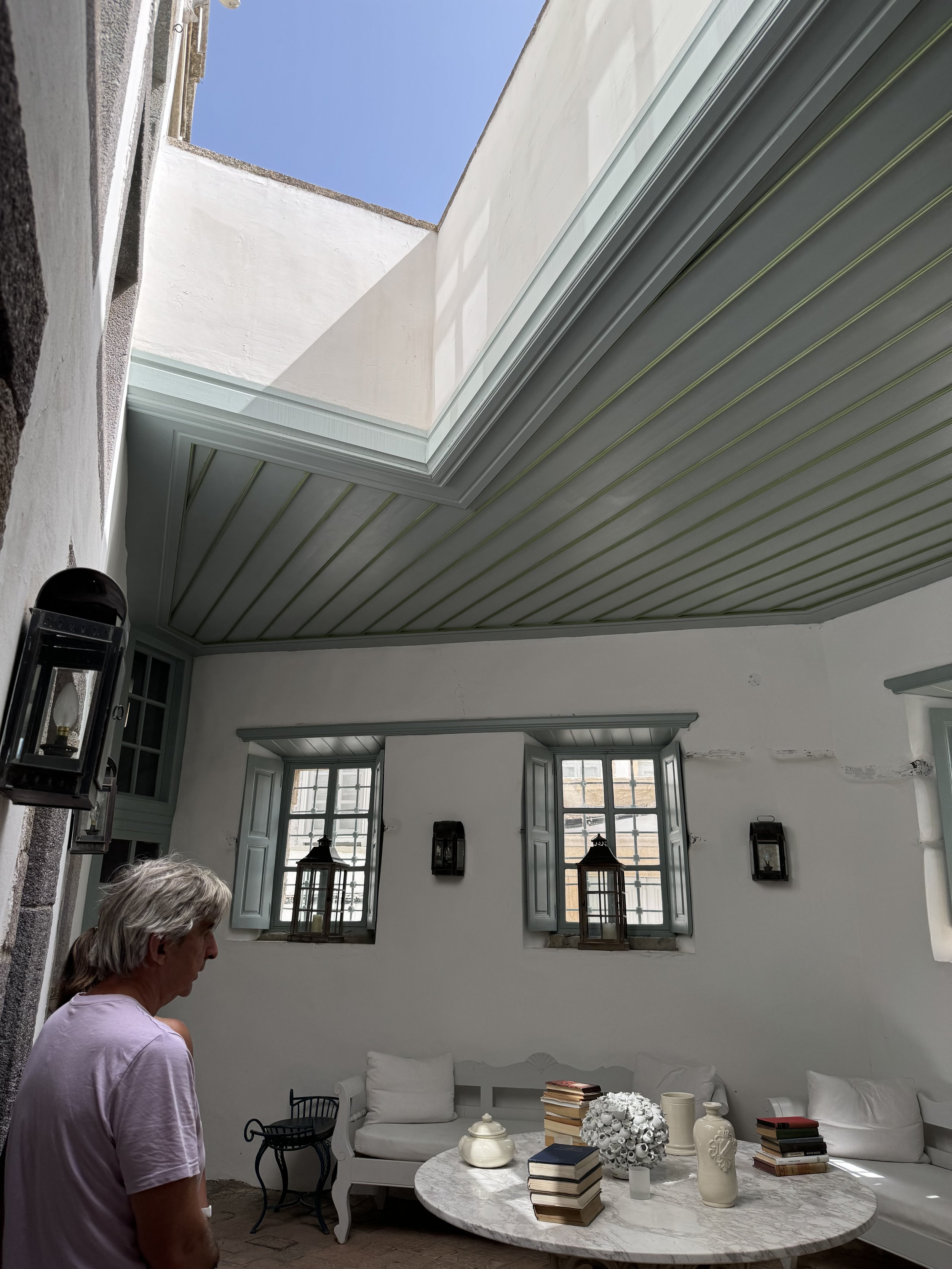
The room was beautifully lit. A completely open view from the ceiling revealed the sky and the source of illumination.
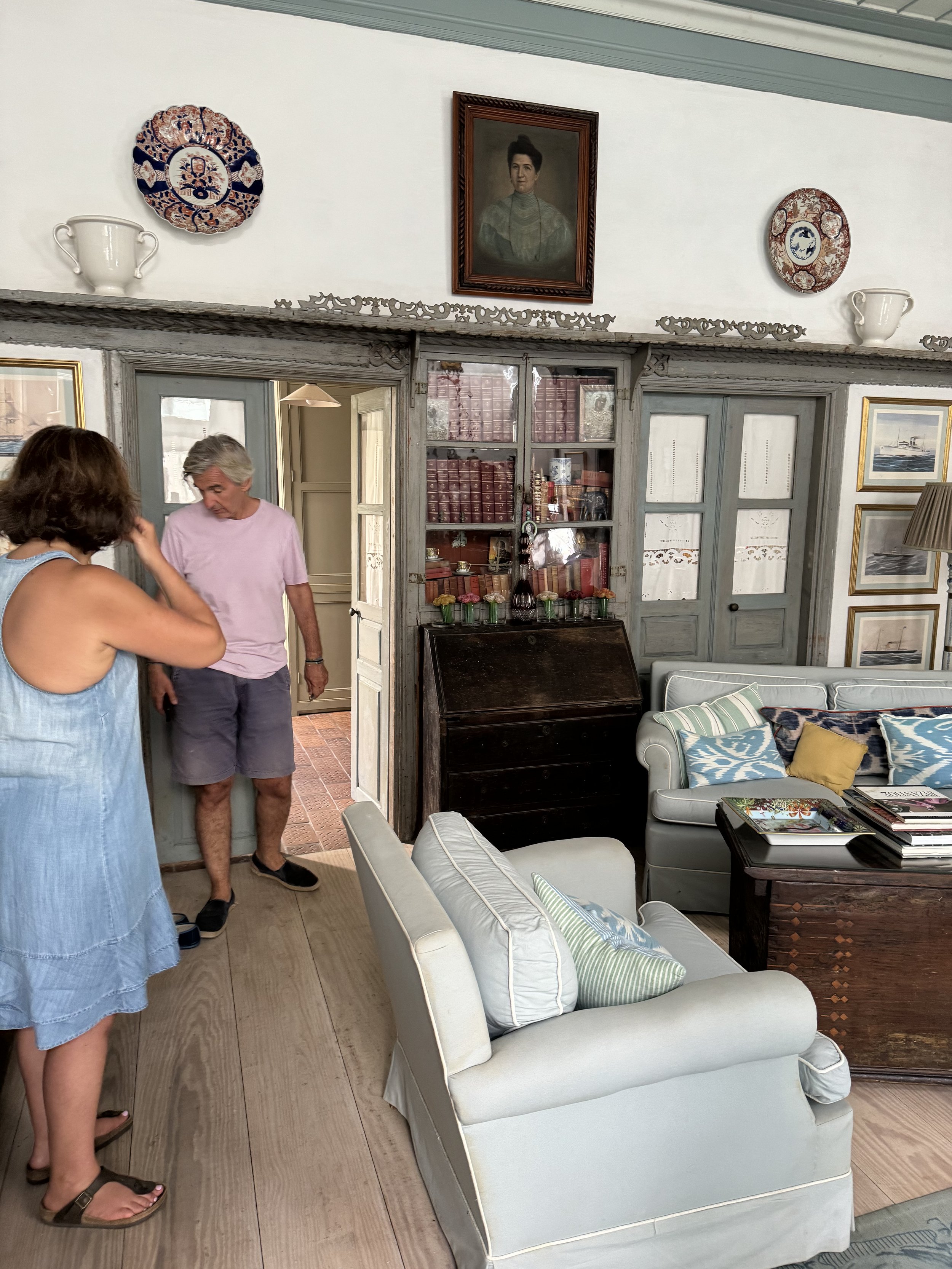
The entryway and sitting room led into a beautifully cozy living area. The portrait of the woman above the books is Calliope Alexakis Dorizas, my Papouli's grandmother. Nautical art decorated the walls and made me think of Vasili Moundreas, Melina’s grandfather, my Papouli’s brother-in-law, who was in shipping, but I forgot to ask if they were original. to the home.
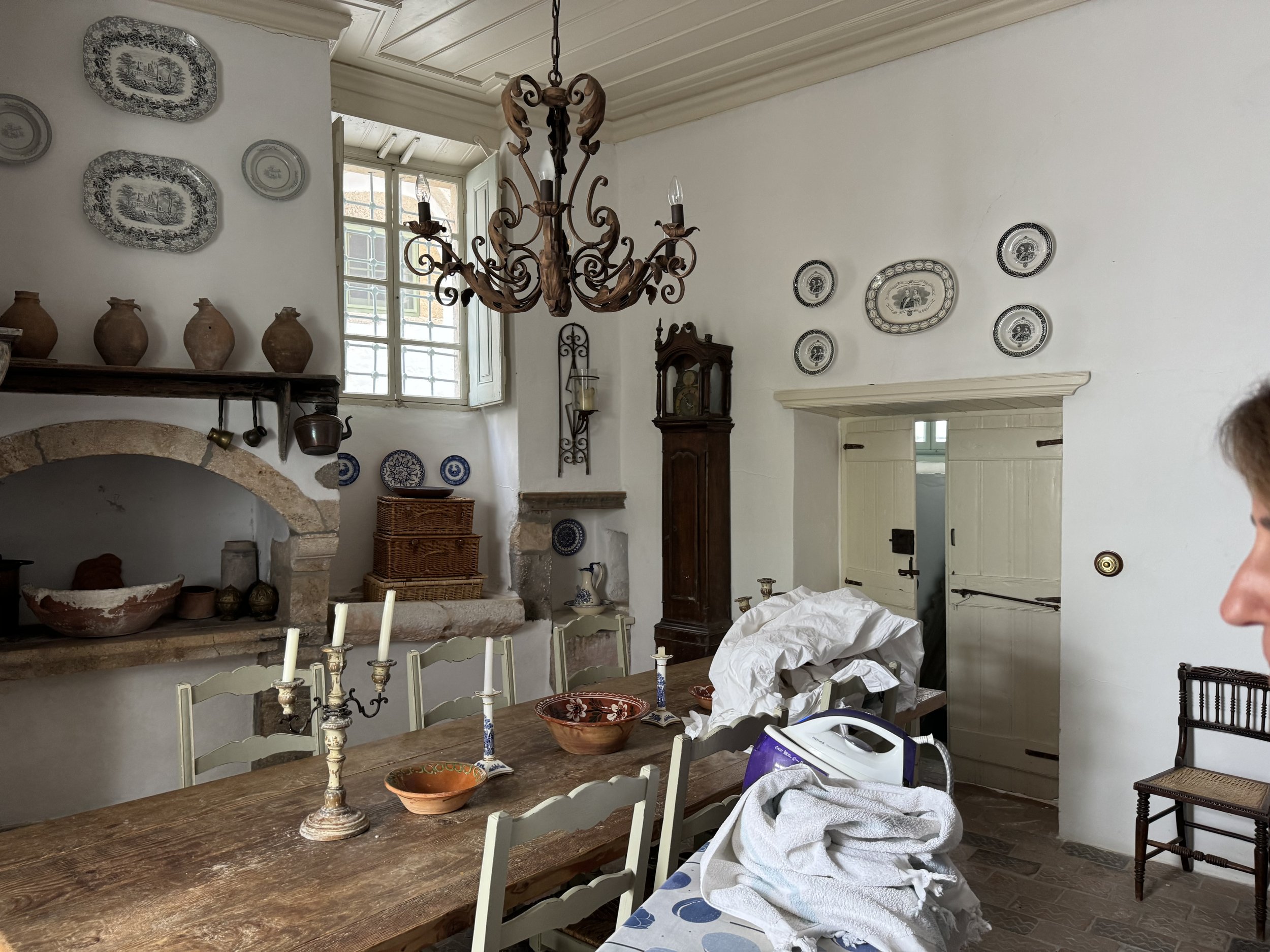
From there, Dimitri took us back into the breakfast room, and showed us the dishes on the wall and the grandfather clock that were original to the home.
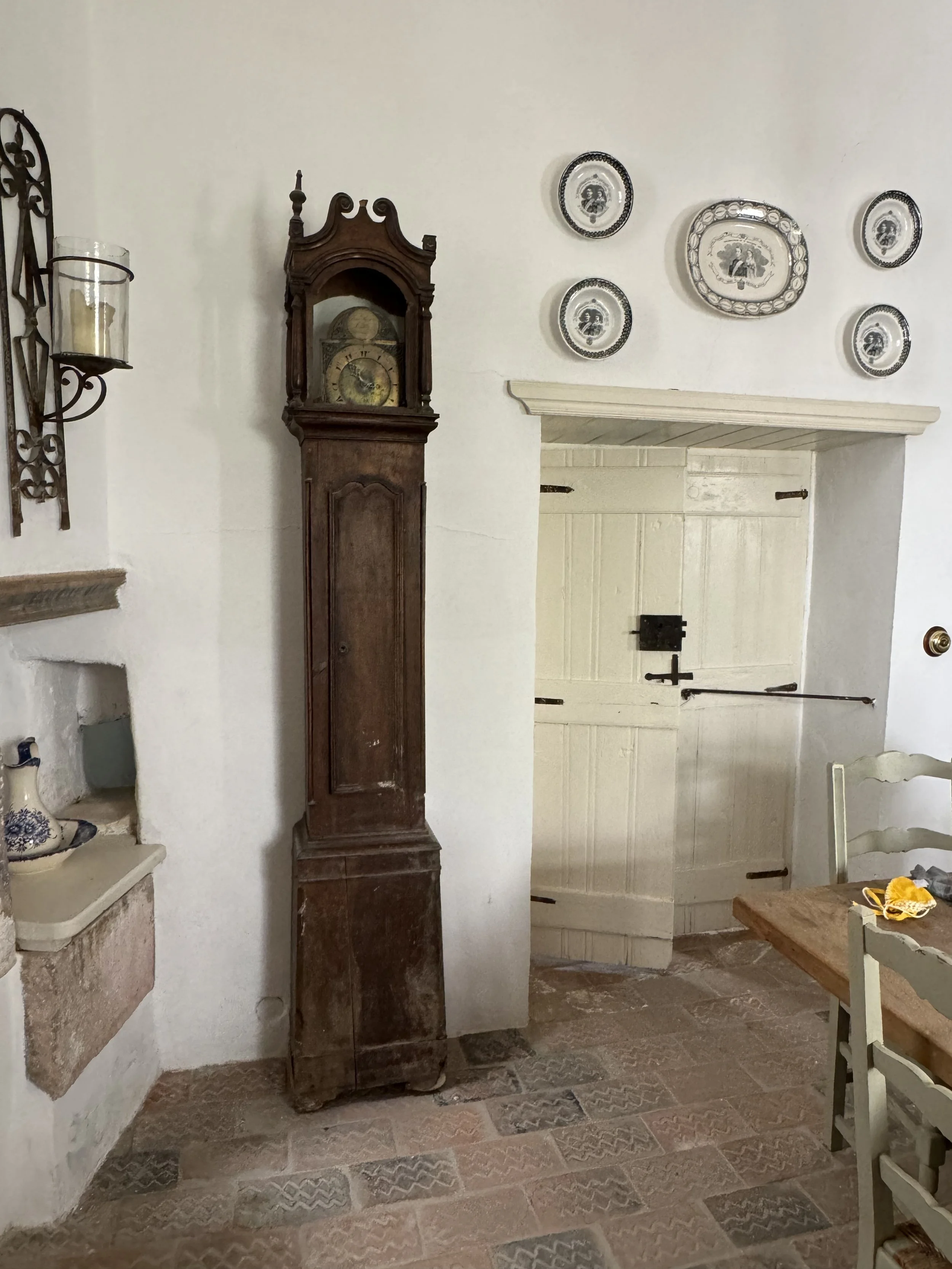
Melina asked in a subsequent phone conversation if we’d noticed a really badly beaten up old grandfather clock. She explained that when they acquired the house, she’d found it in pieces and began putting it back together. As she reassembled it, she noticed the name Isaac Rogers and said she remarked, “How insane! Here we are standing in Patmos, finding an authentic Isaac Rogers grandfather clock from London!”
I’d never heard of Isaac Rogers, but the internet revealed that he was a prolific maker of musical clocks in London, circa 1785.
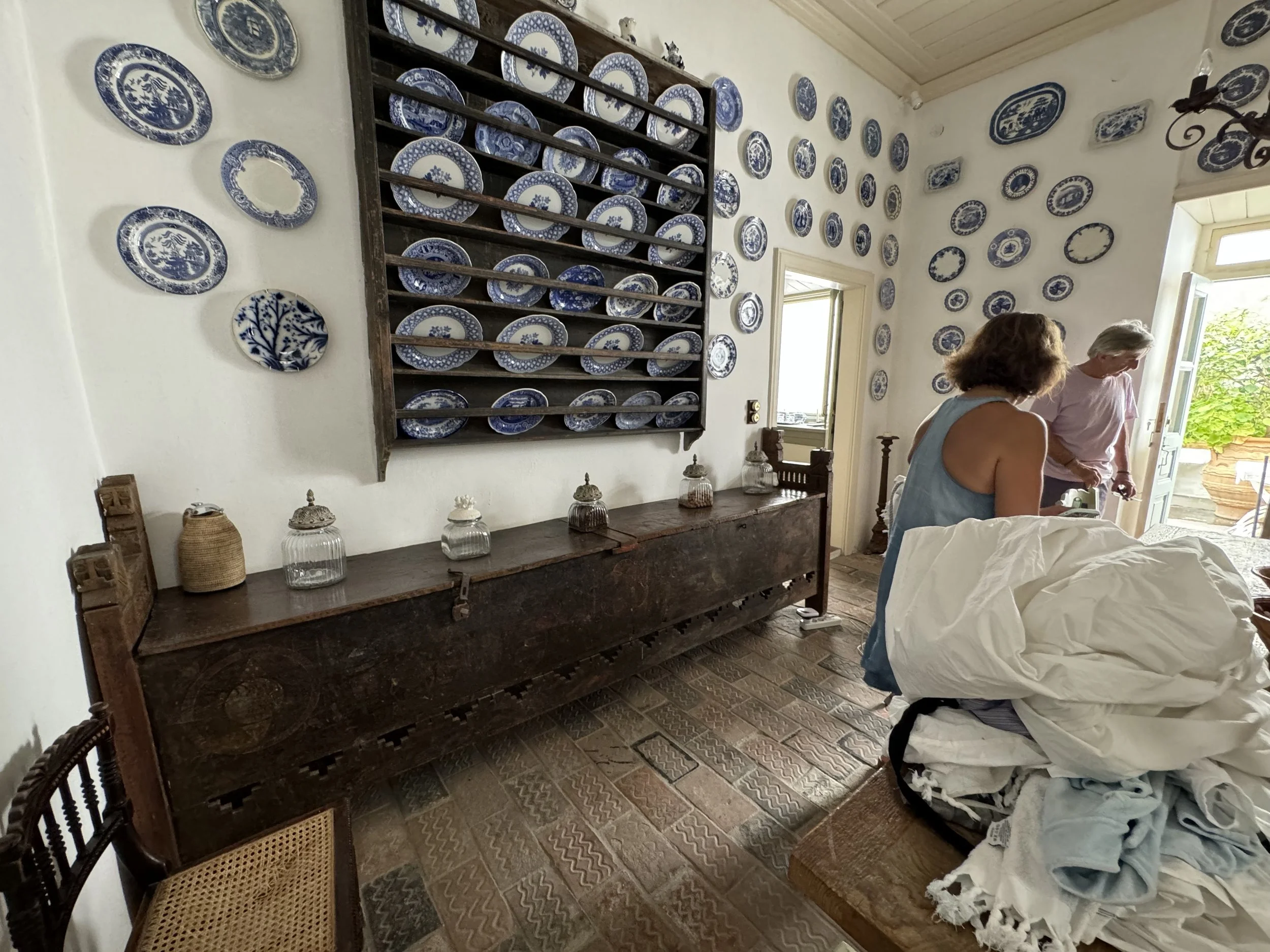
Seeing the very dishes my Papouli and his family would have eaten from thrilled me. Then I imagined hearing the chimes of the grandfather clock and thought of my dad’s collection of antique clocks and his joy of setting them so that they all chimed together.
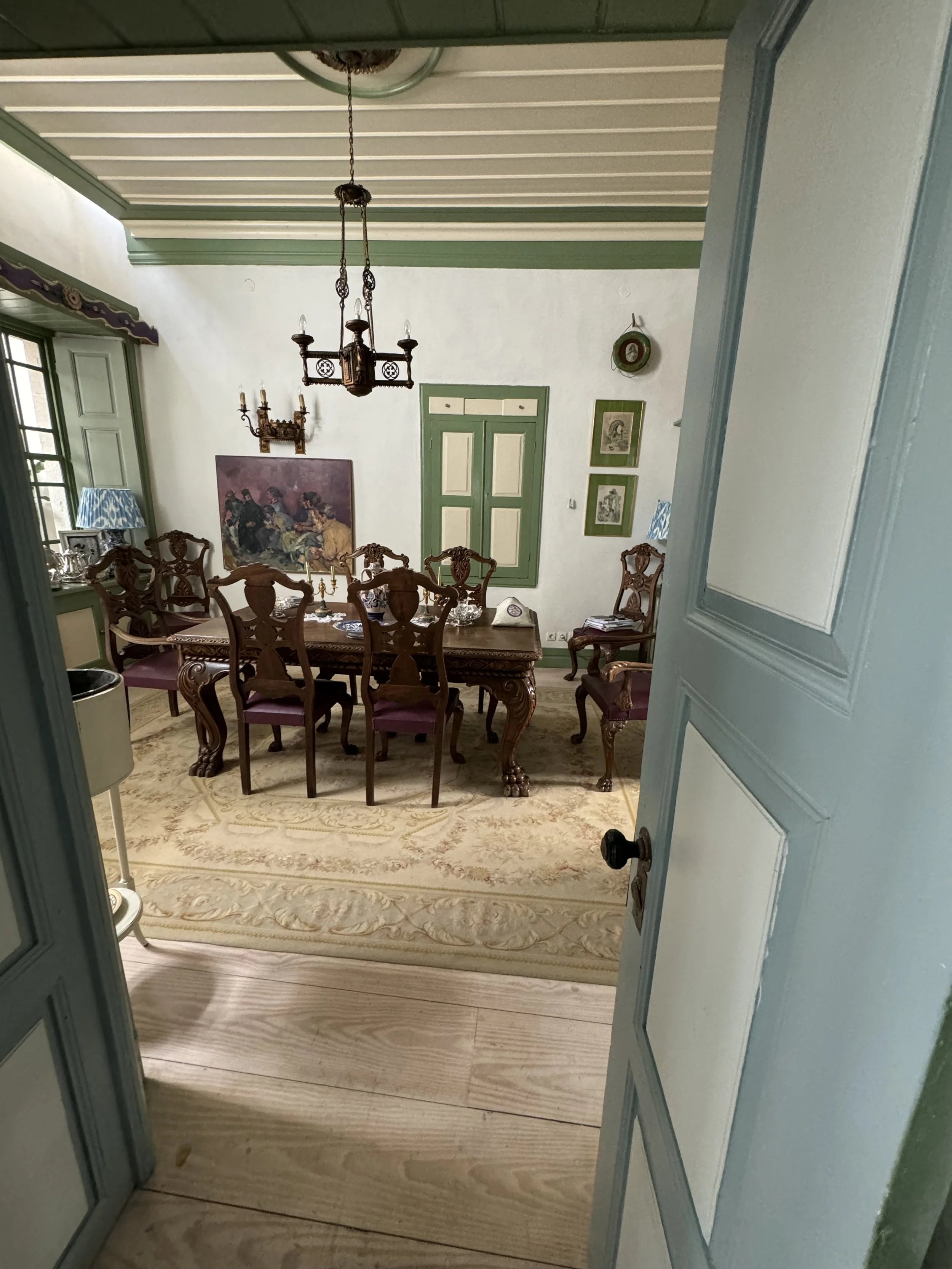
In the dining room, Dimitri talked about going to the archives in the Monastery and all the information he was able to discover about our family. His notes are all in Greek, but he said he would type them up and send them to us. I can’t wait!
My sister, Niki, had just returned with her family from Patmos–we planned our trips independently of each other and only discovered in May that we both had trips planned–back-to-back! She’s been investigating getting Greek citizenship, which apparently is possible if you can prove that one of your grandparents was born in Greece or had Greek citizenship.
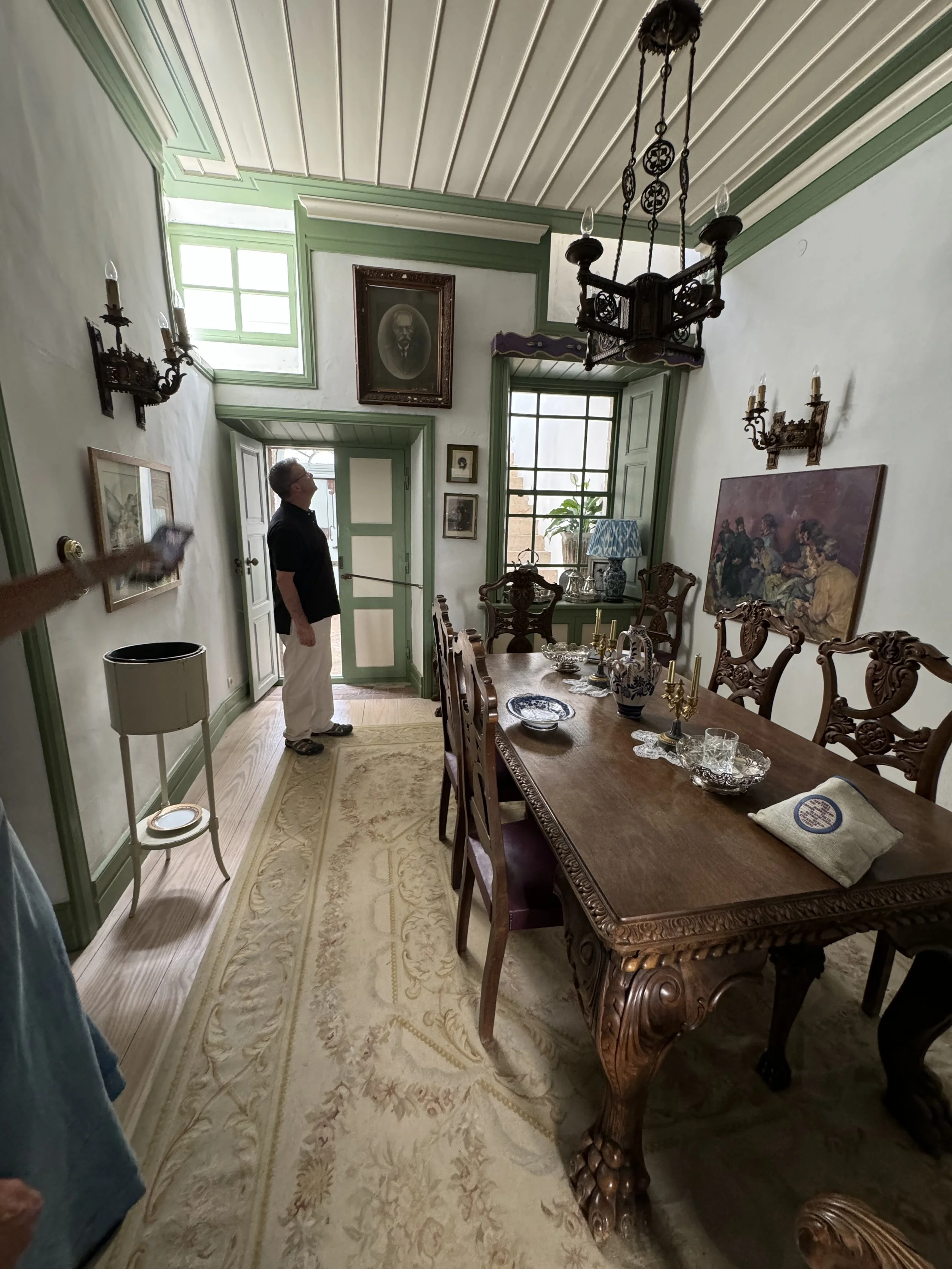
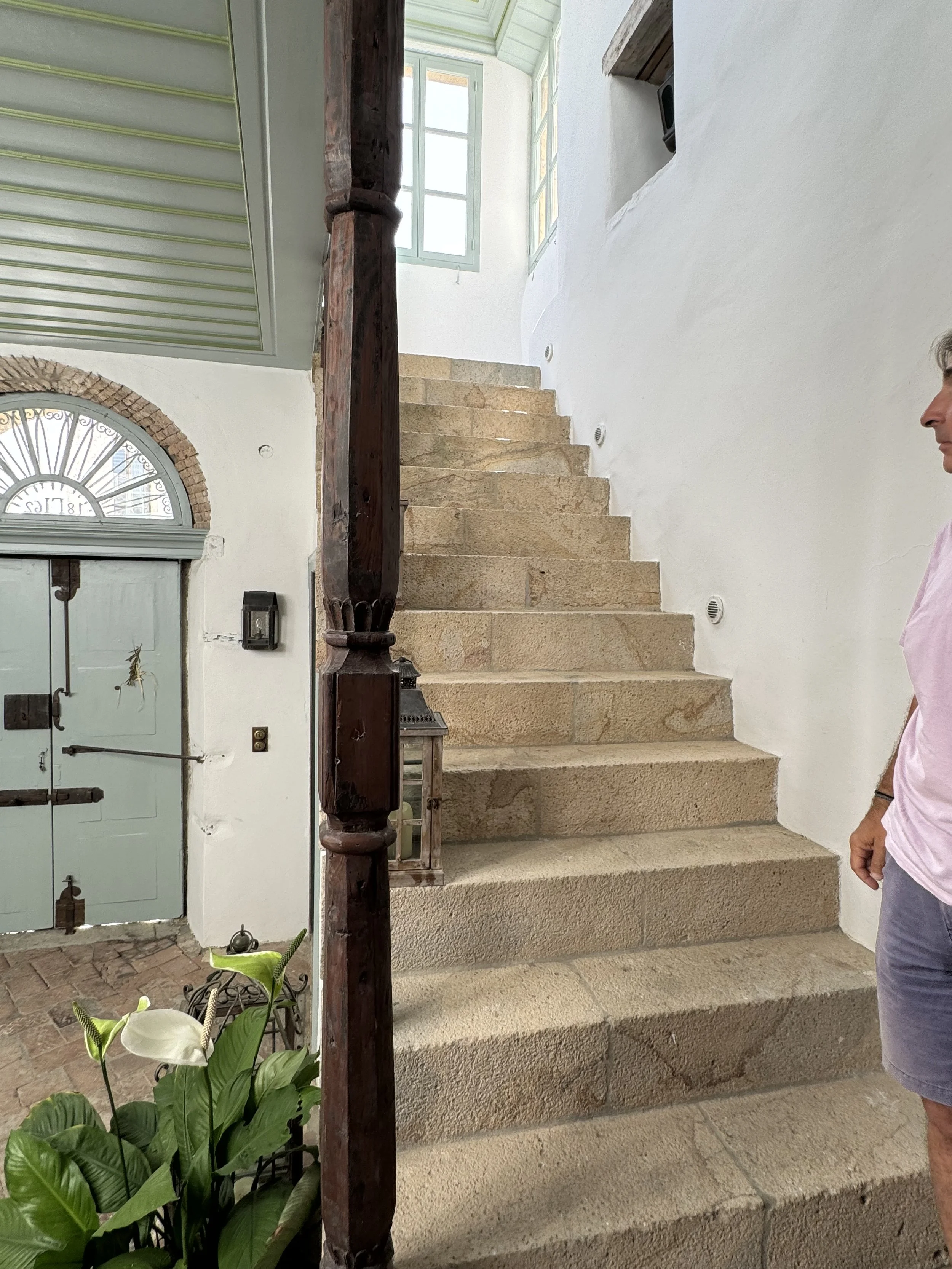
After seeing the downstairs, we went back to the sunlit room to access the staircase upstairs.
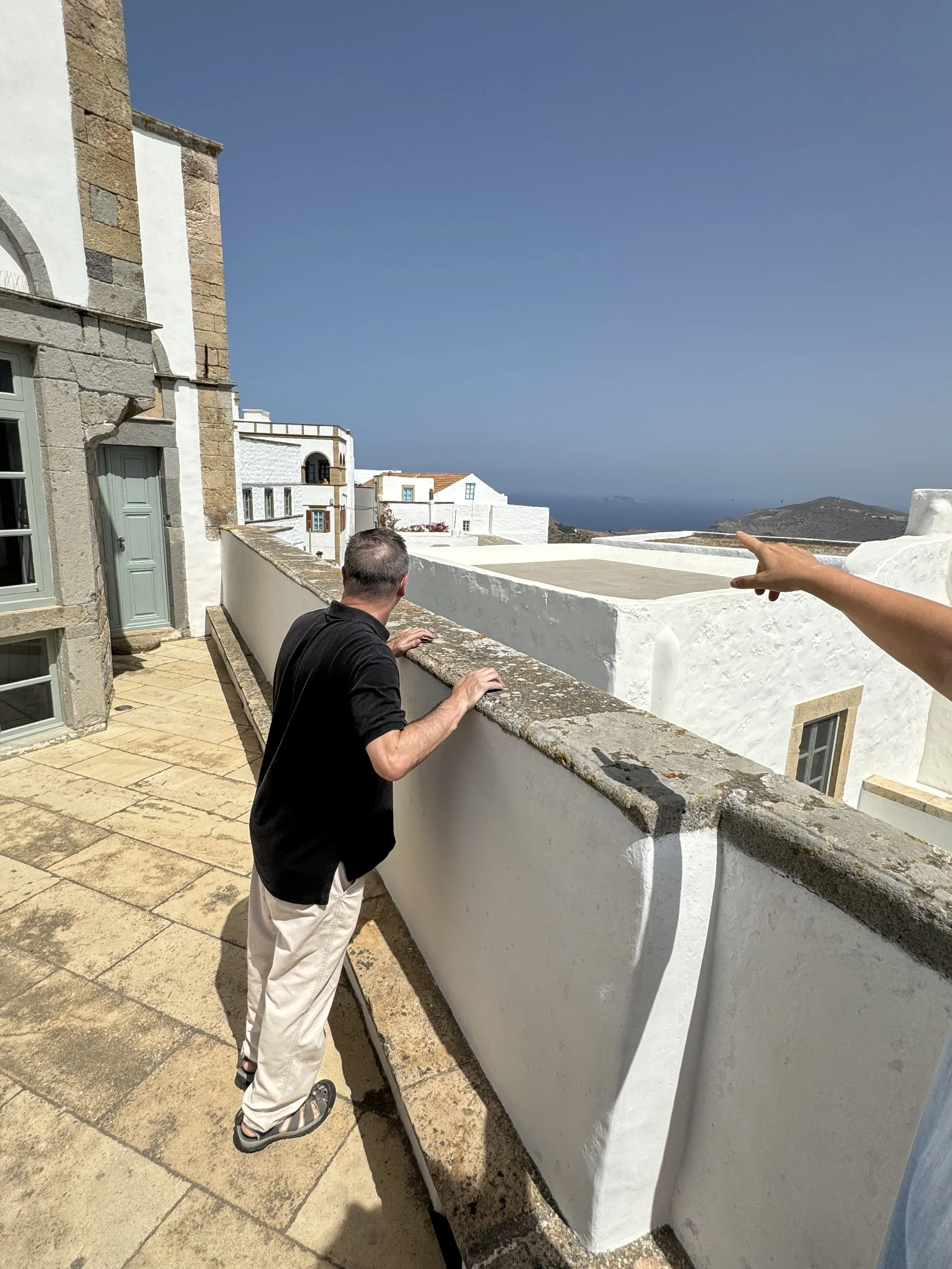
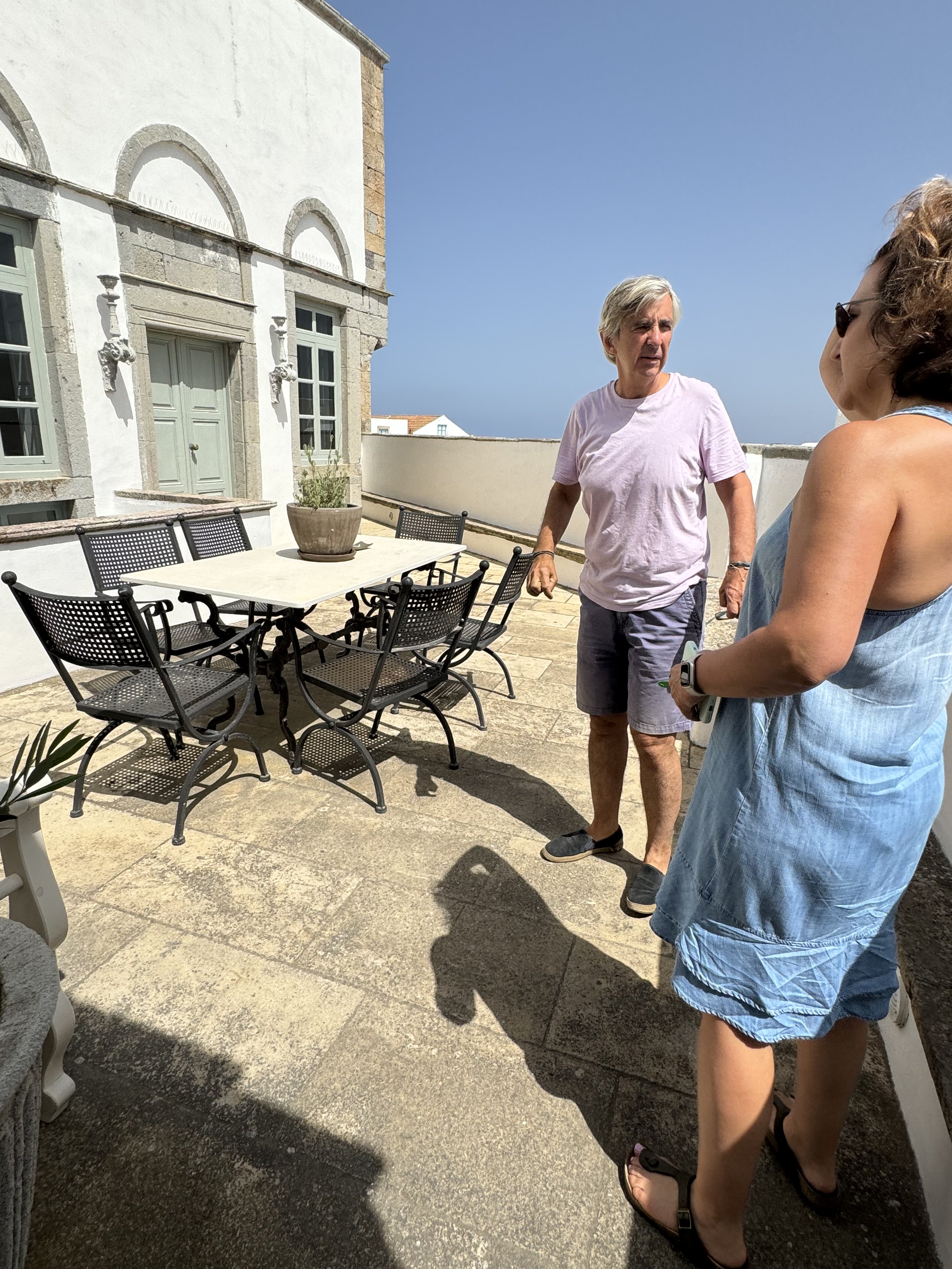
What a surprise to find that the staircase opened to a sitting area on the roof before leading into more rooms.
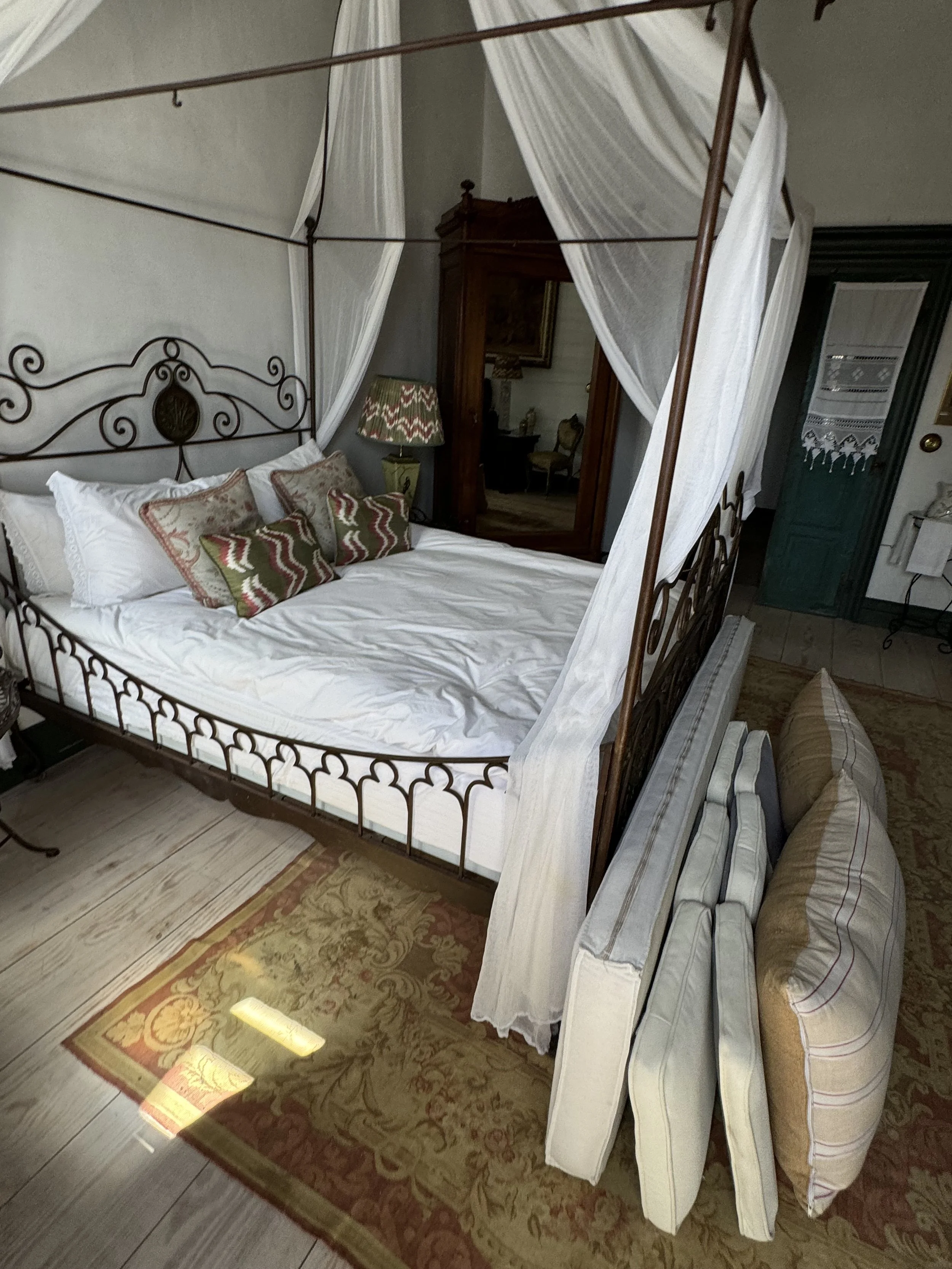
The first room we entered was a bedroom that contained a bed frame that they had found in the home.
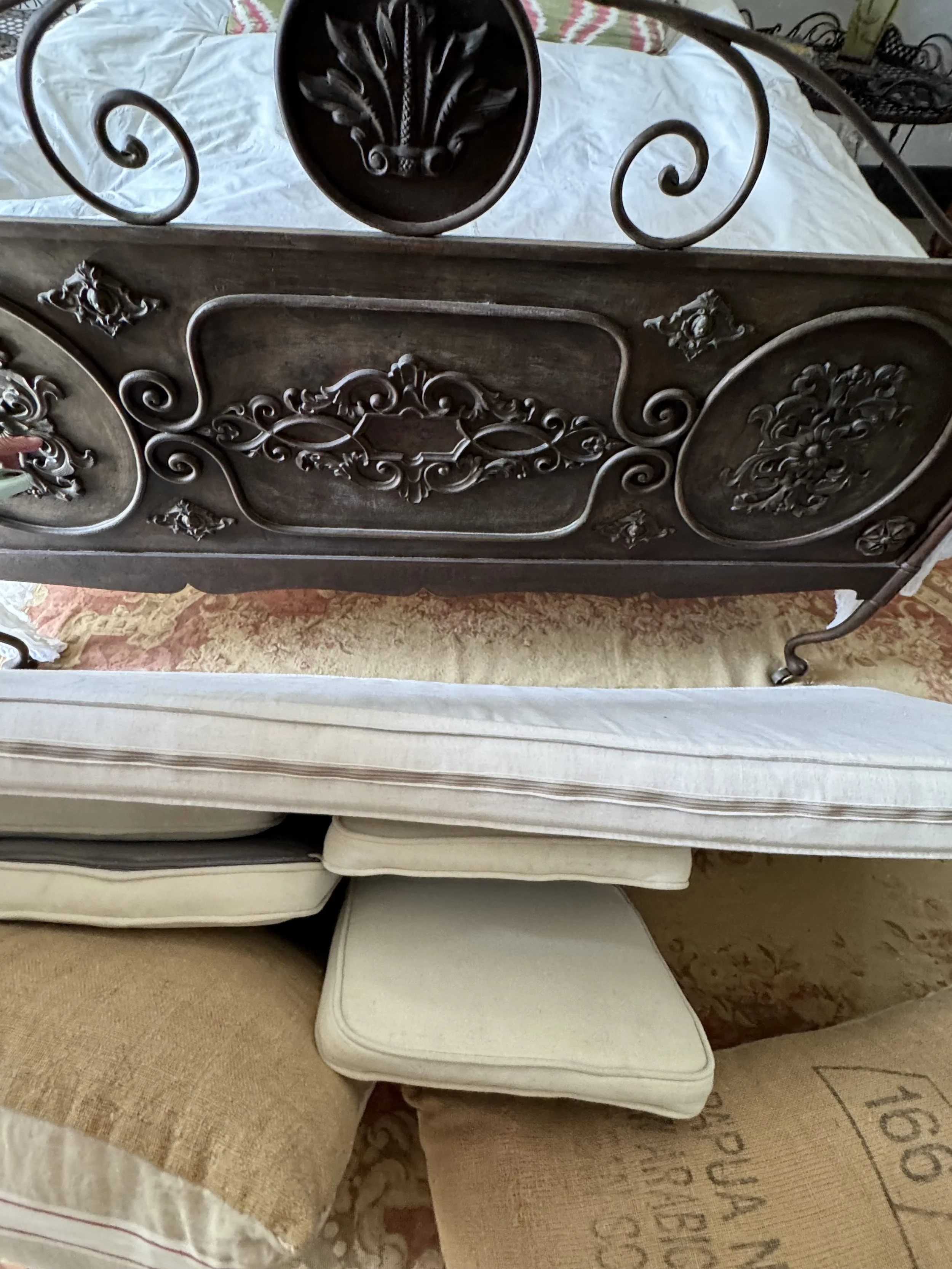
If you zoom in, you see the year 1863, and in the open space in the engraving are initials.
Melina figured out last year that they match Georgos Ippokratides, our Yaya Calliope’s grandfather.
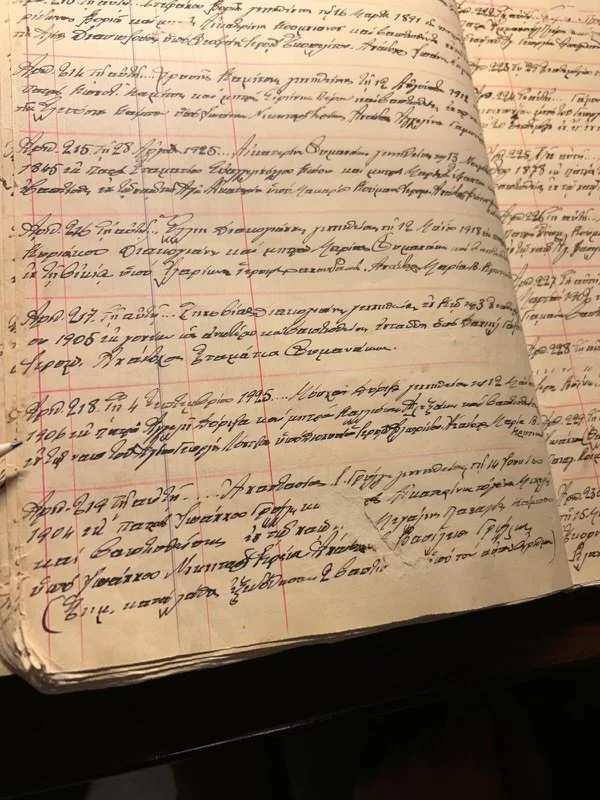
Melina also found a document with the writing of our great-great grandfather, Georgos Ippokratides, displaying exquisite penmanship.
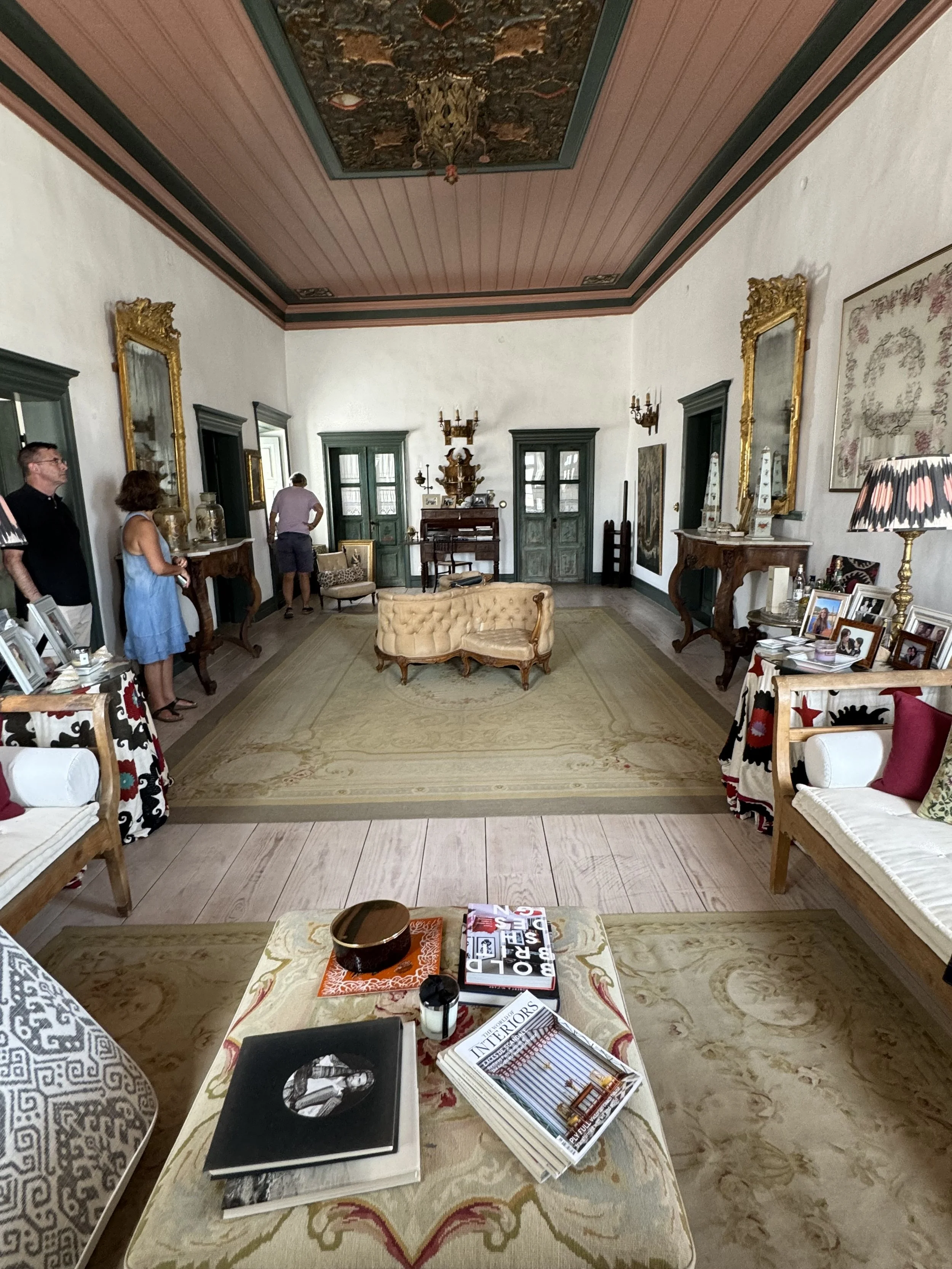
From there, we entered the side entrance of a great upstairs living area. In this photo, I’m taking the photo from one end, and Wally and Cookie are entering the doorway.
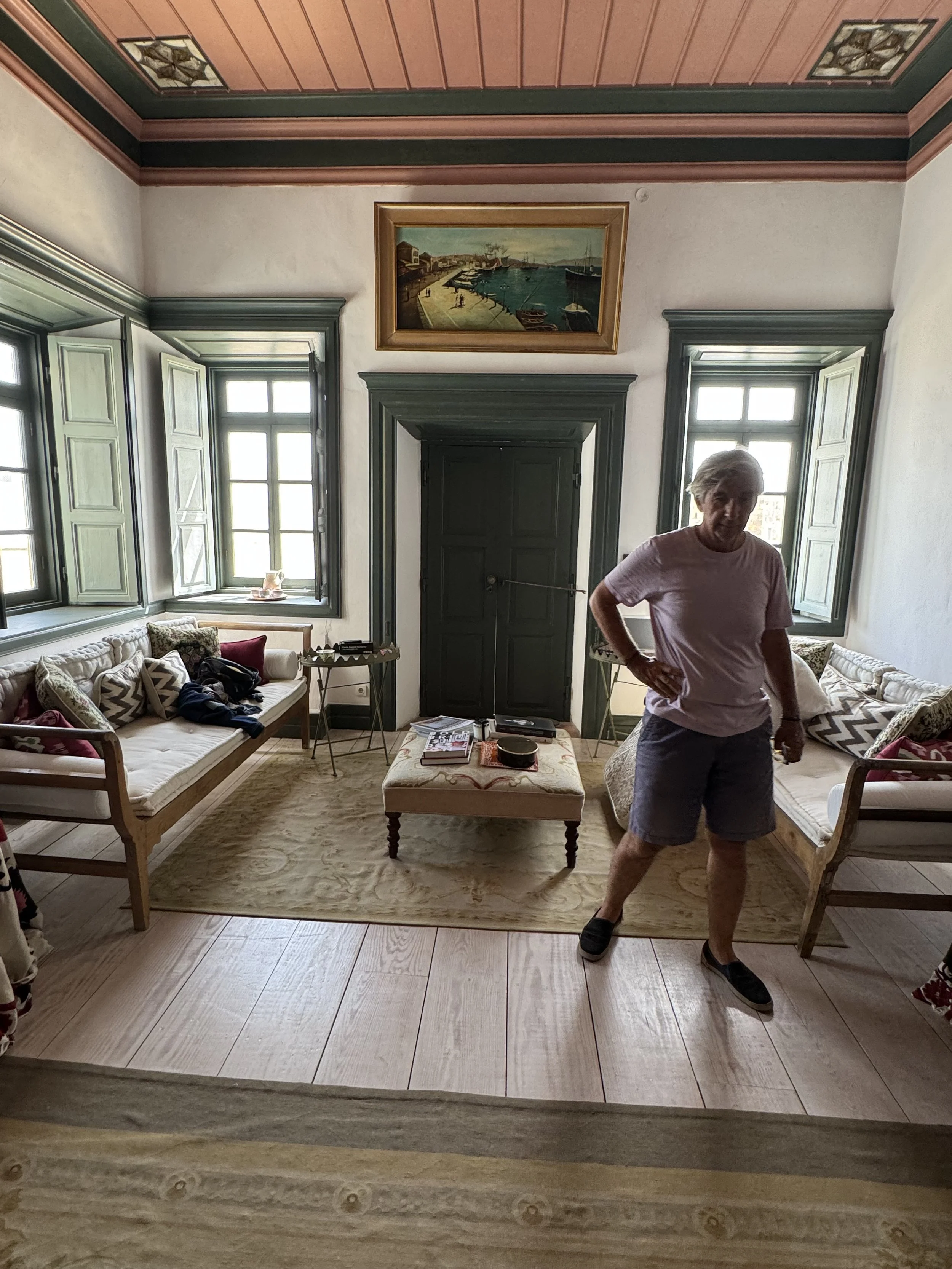
The next photo is of the other end, taken from around the midpoint. Notice the ceiling. It is not original, as it had collapsed and you could see the sky from the first floor all the way through the second floor.
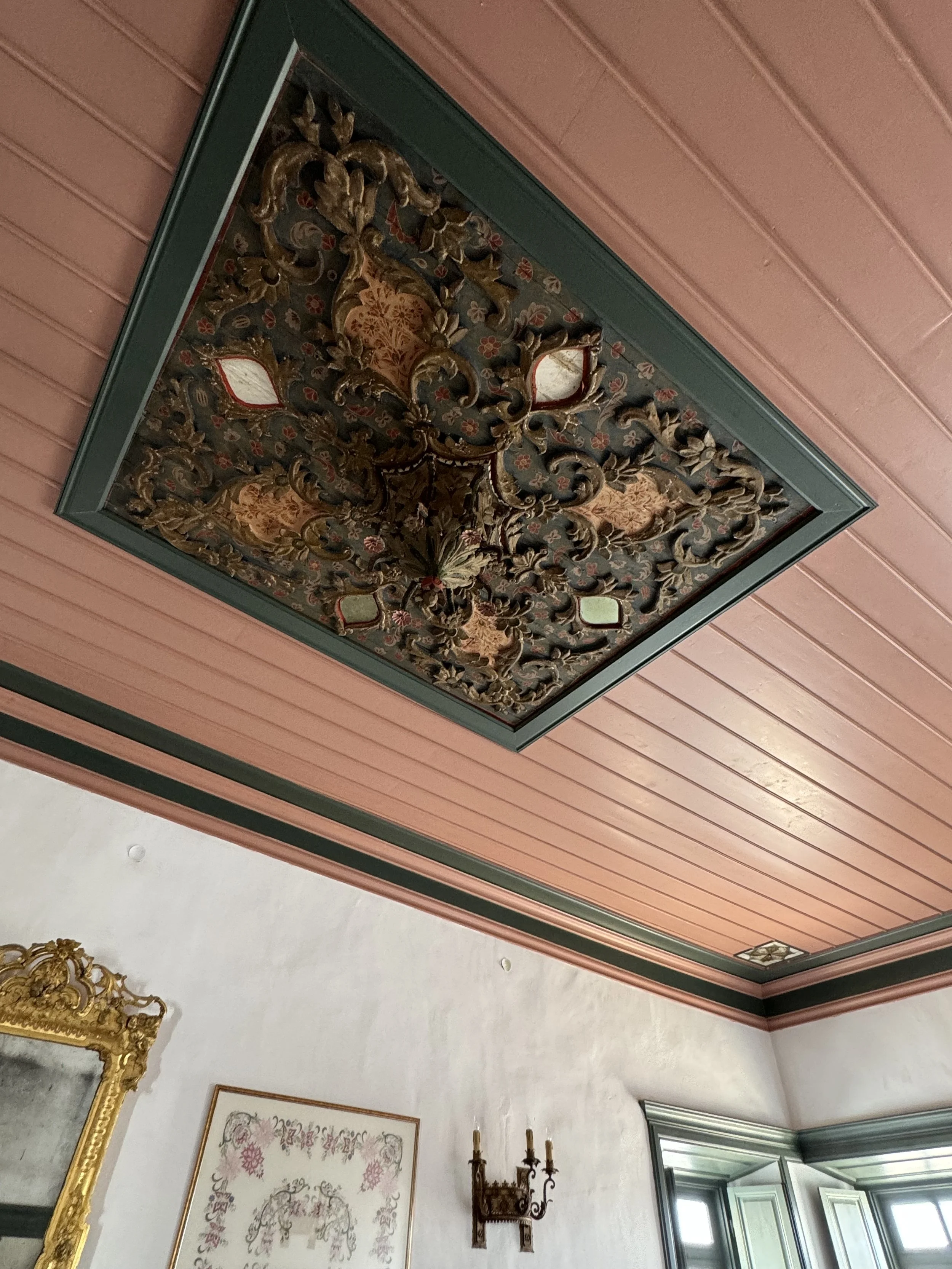
And here’s a photo just of the ceiling.
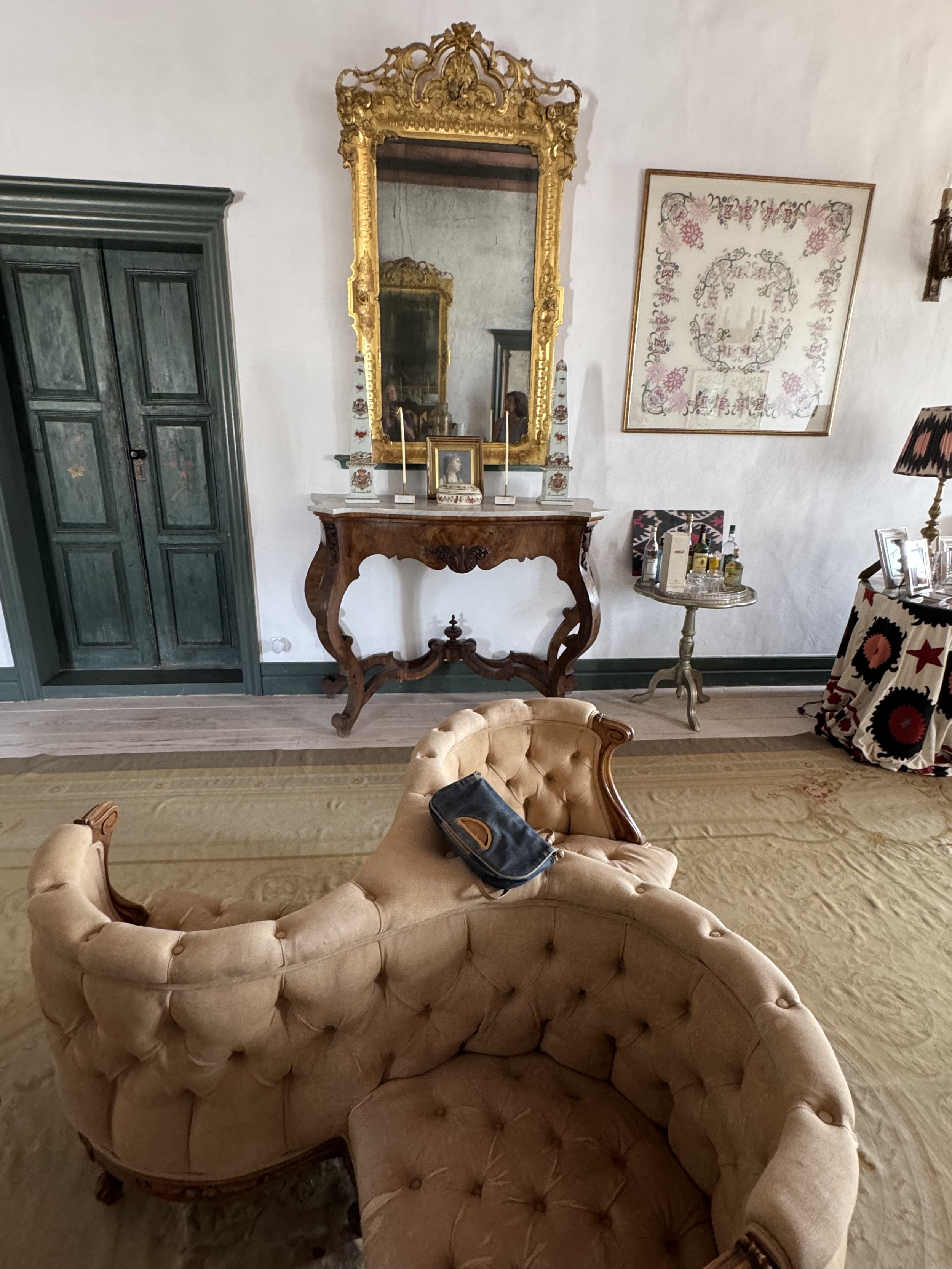
Two gold-framed mirrors face each other in the center of the room. They and the tables beneath them are original to the home.
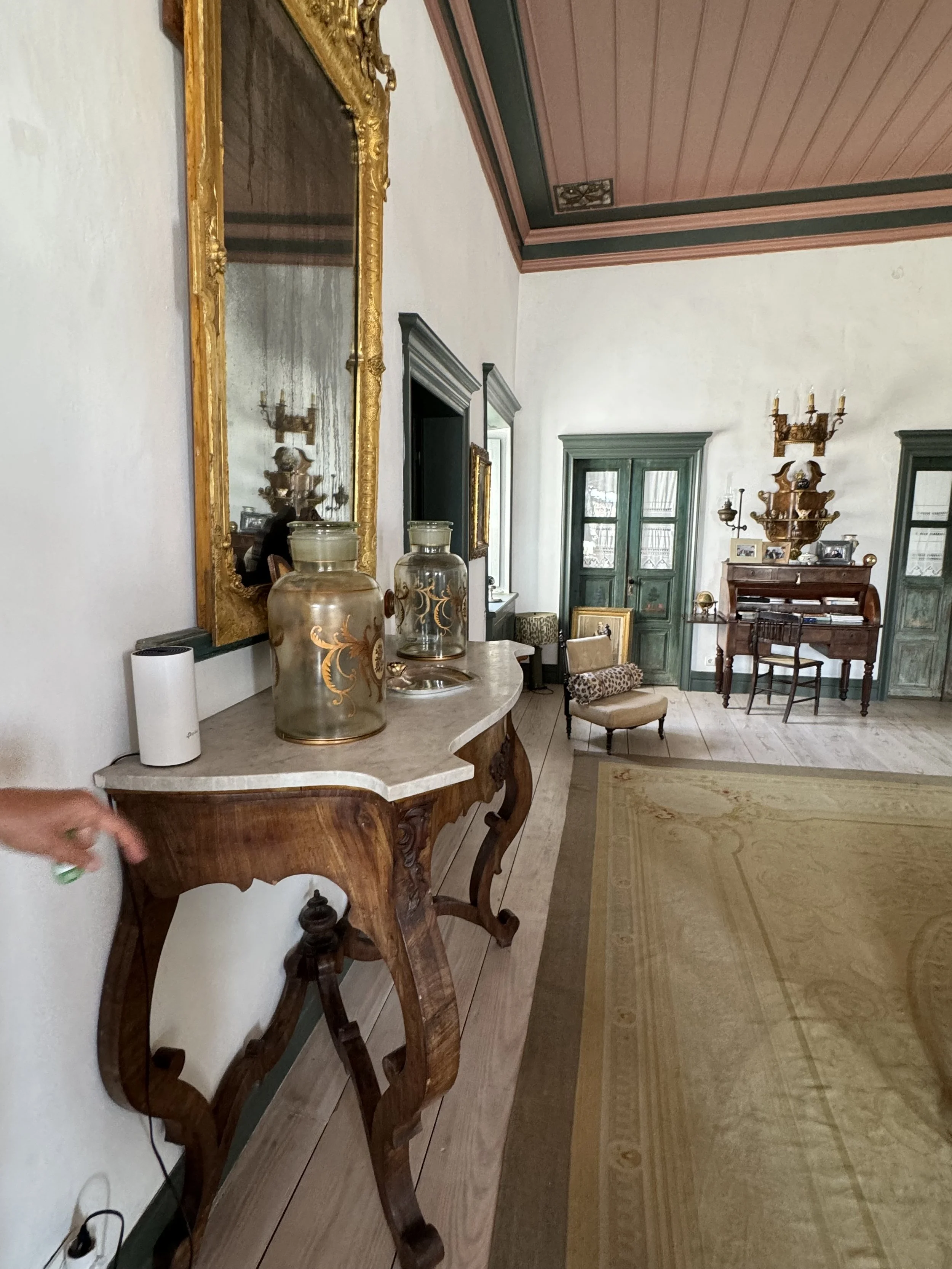
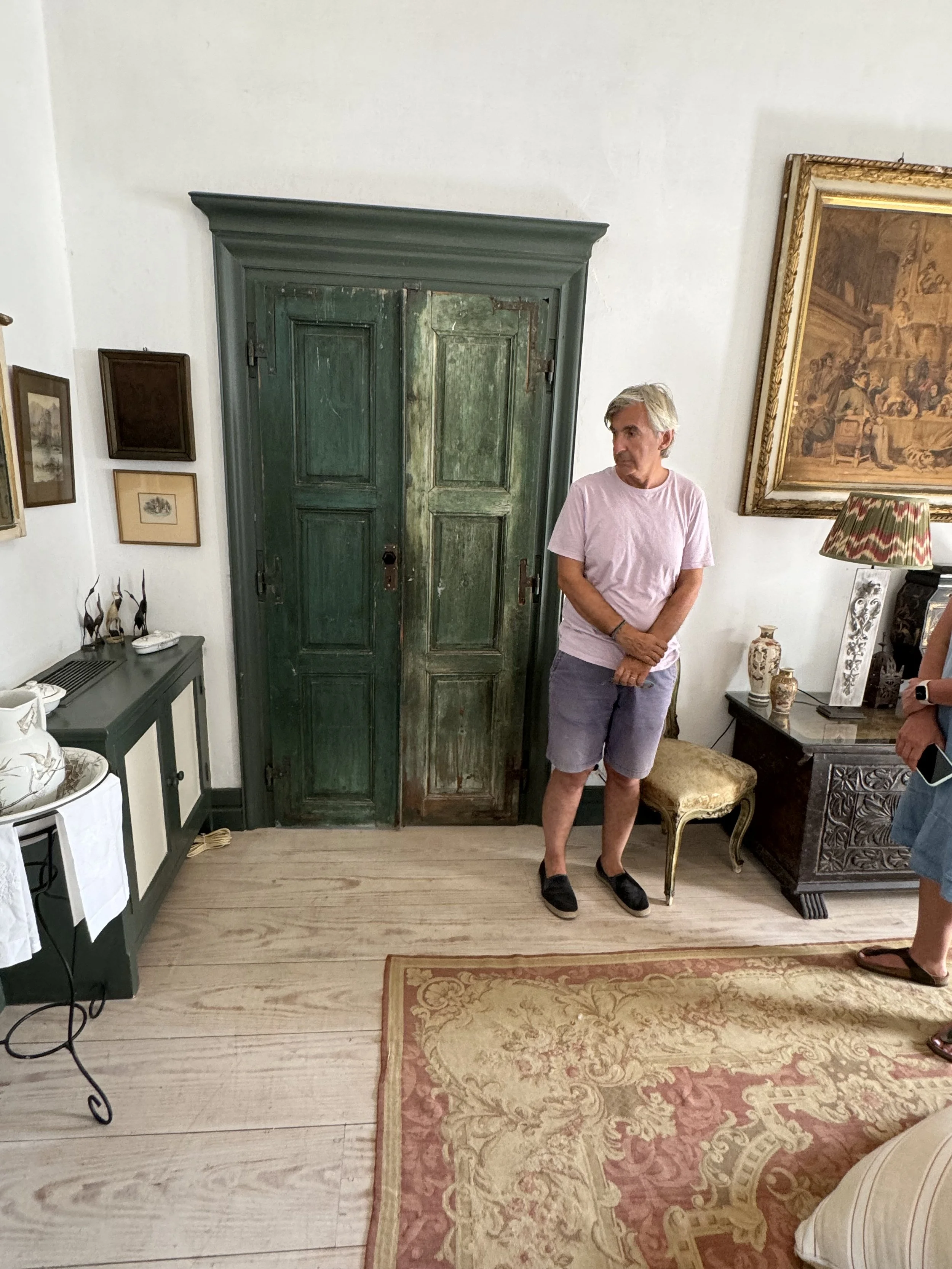
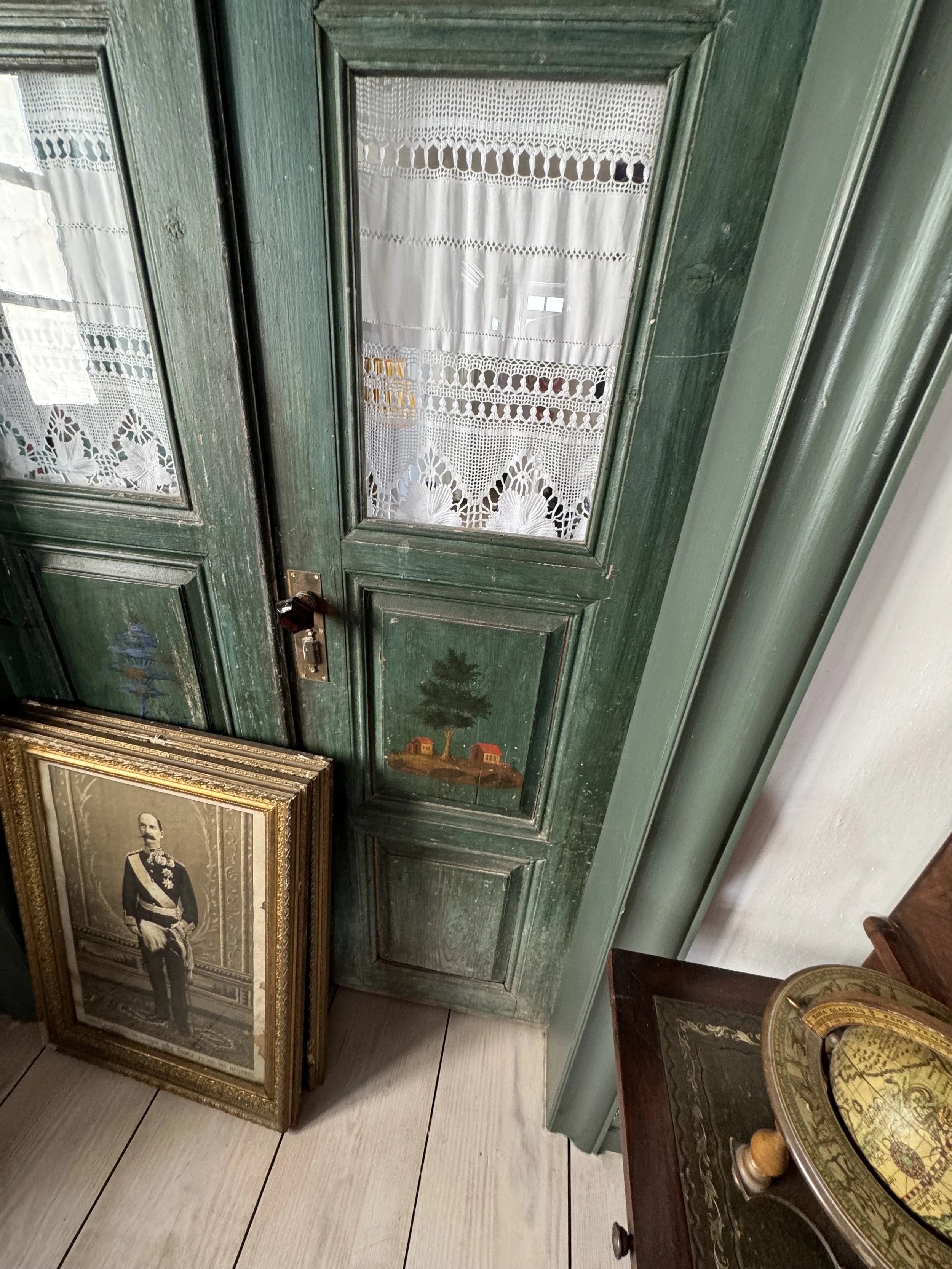
Dimitri pointed out the doors–all original to the home–and the door knobs, made of some kind of stone.
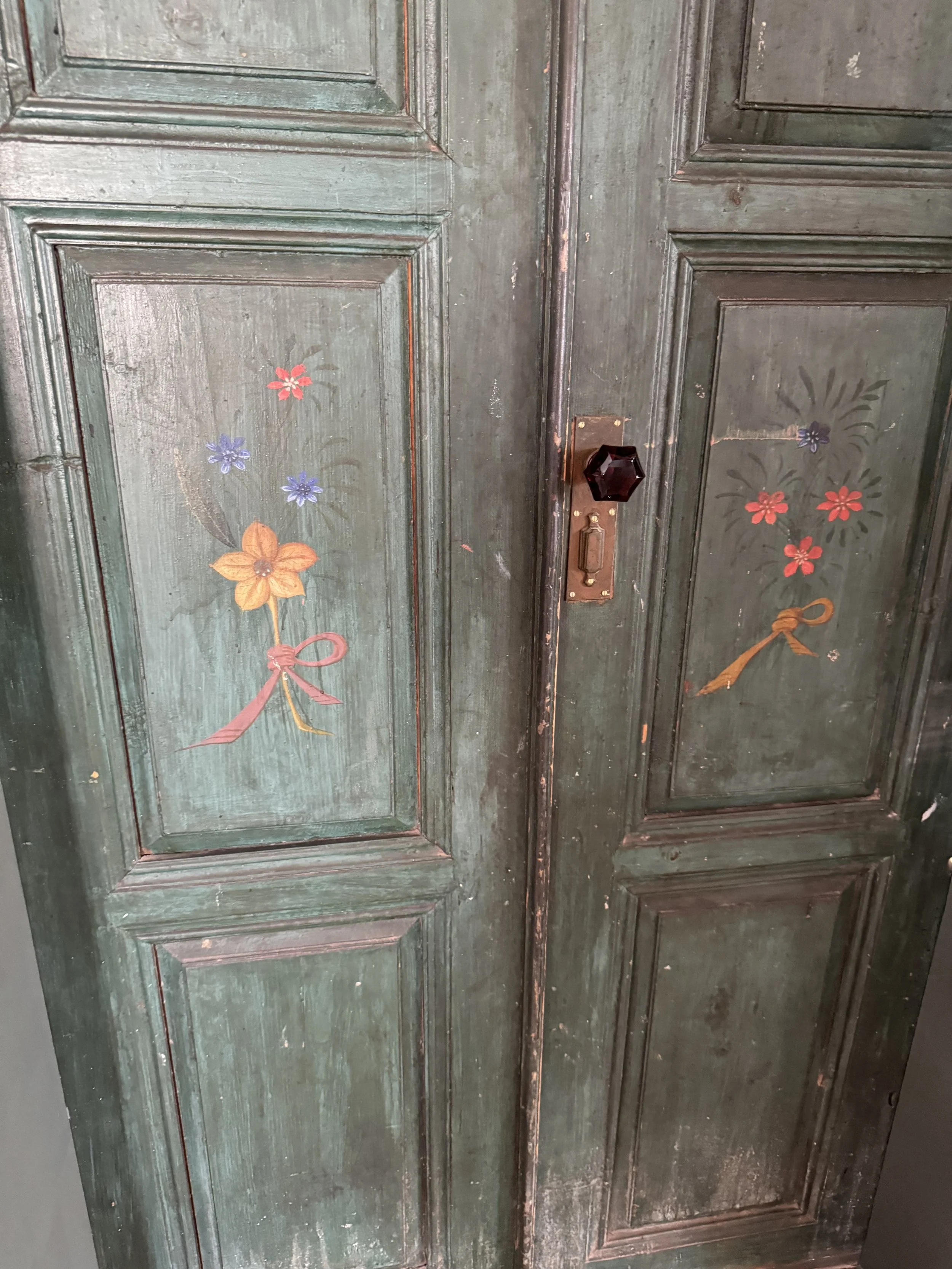
Door after door featured intricately hand-painted exquisite designs.
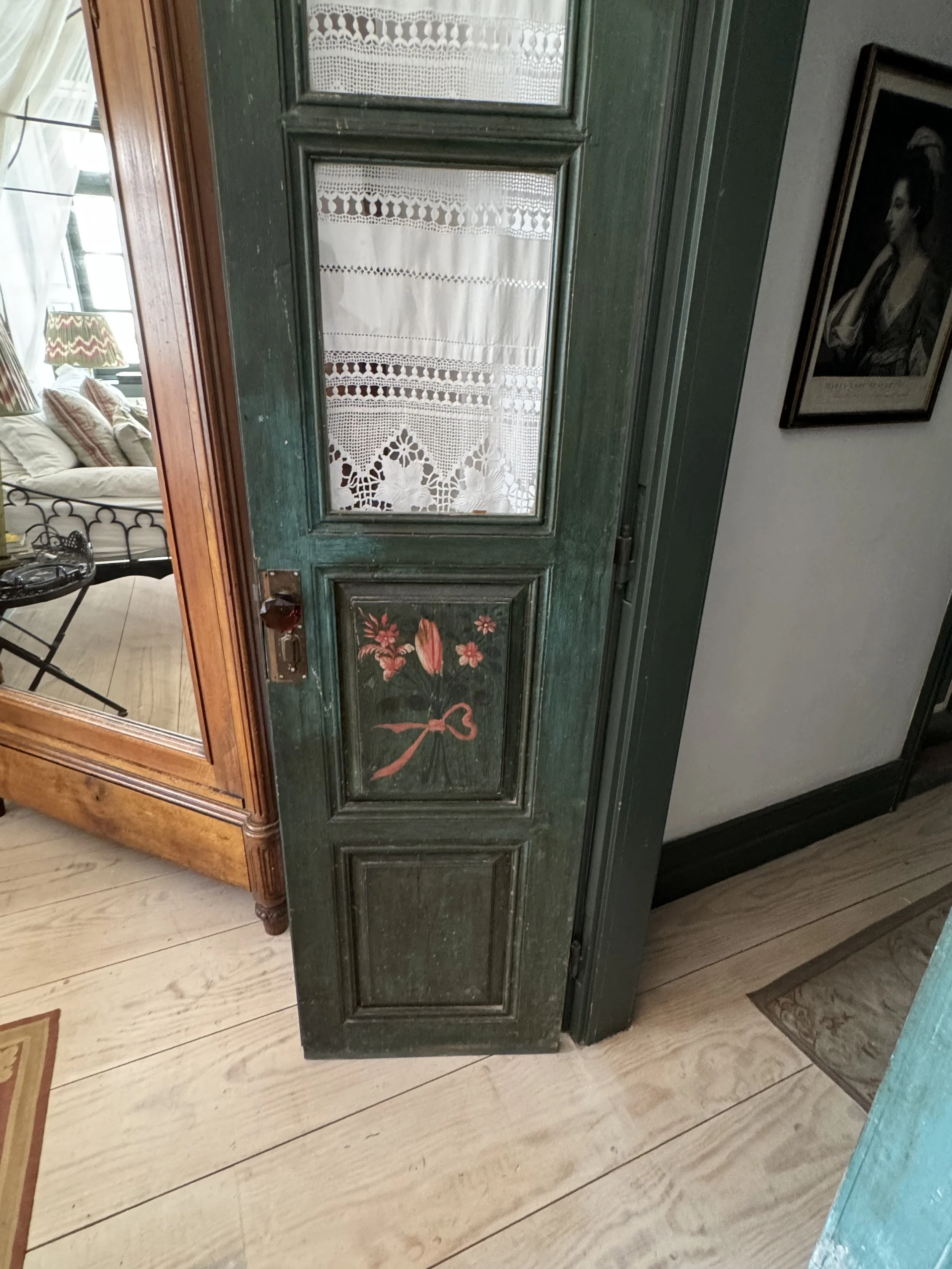
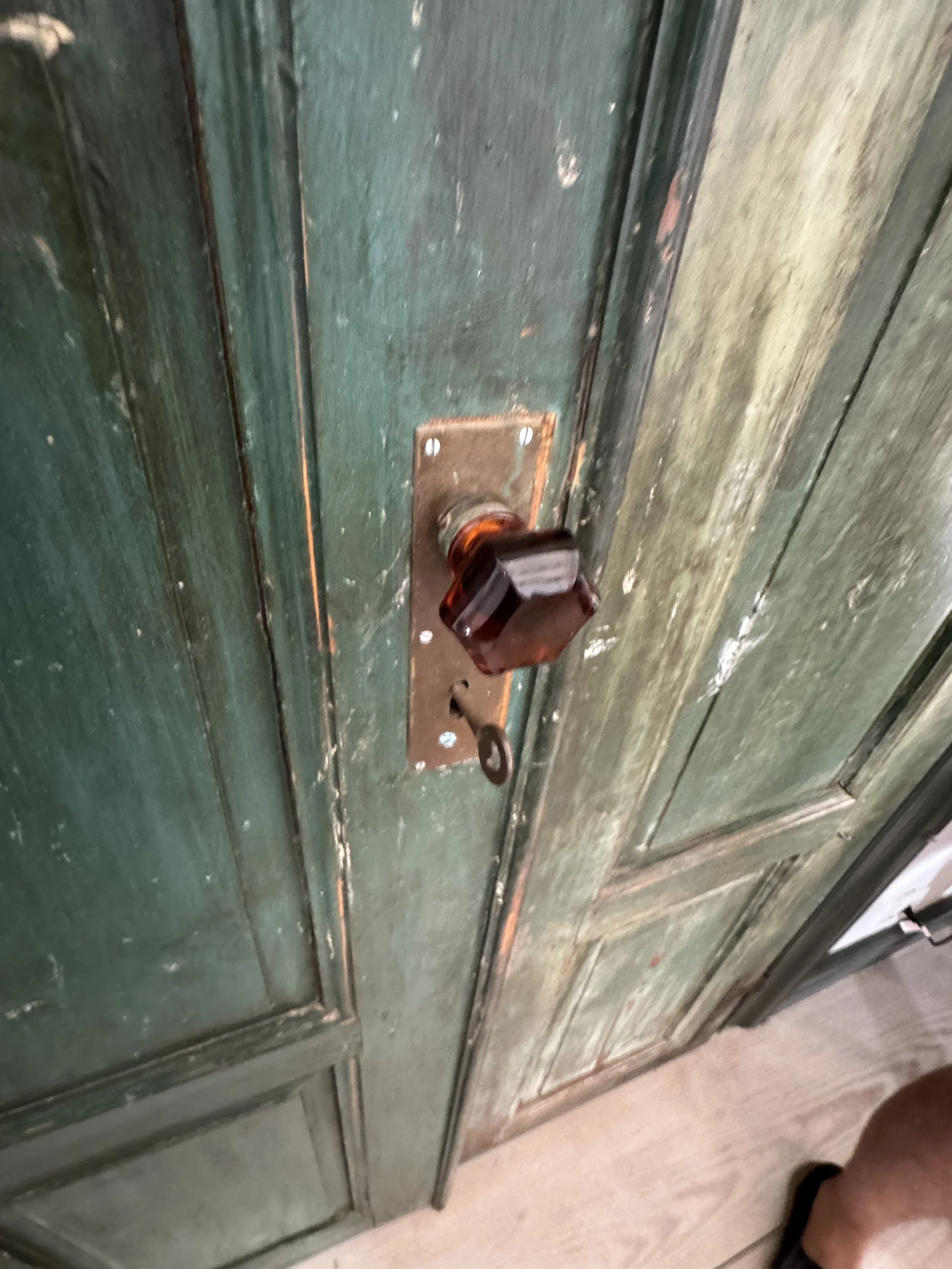
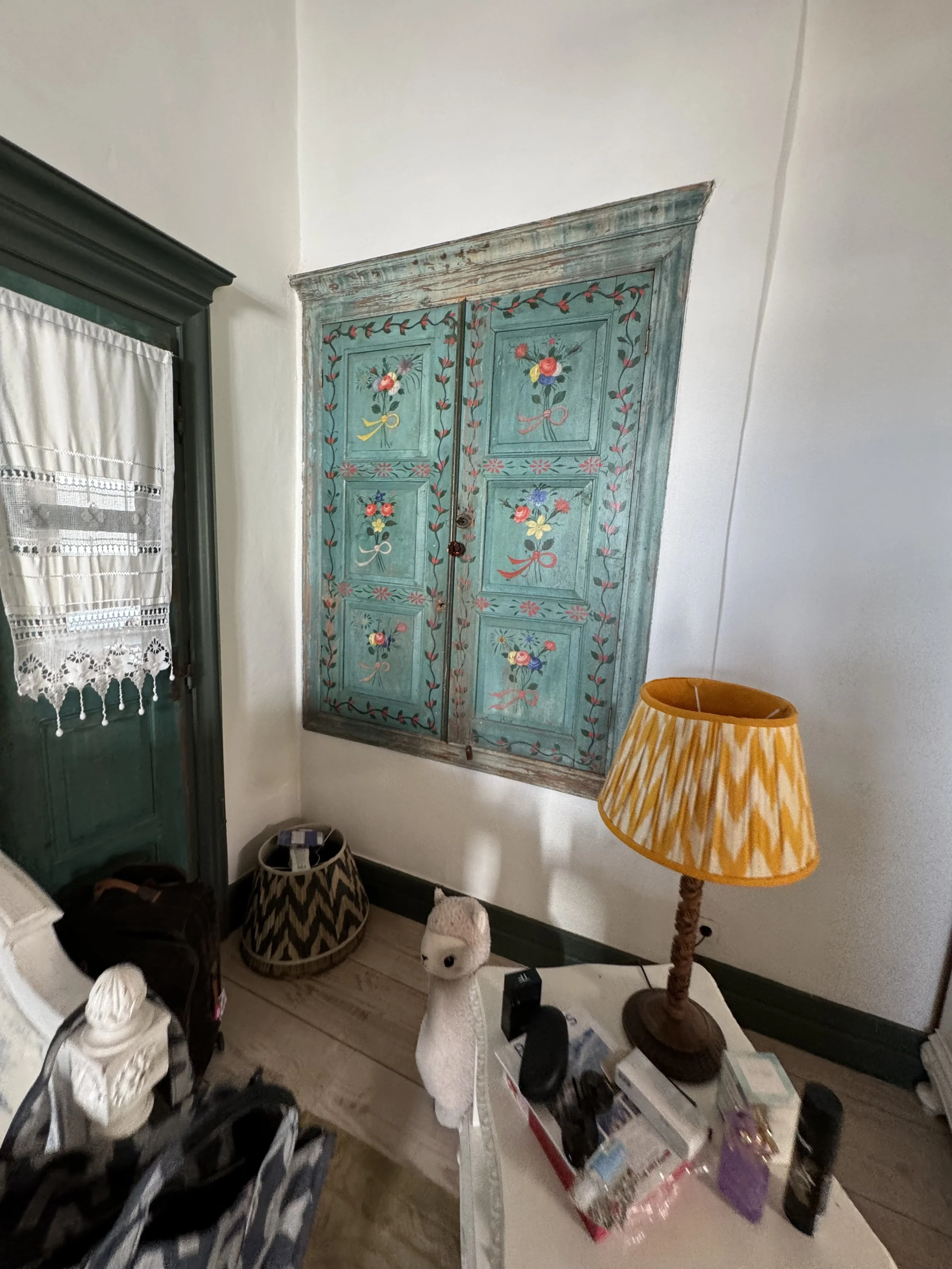
Melina commented more about the home–“beautiful crystal chandeliers and glasses with initials in pure gold”–which had been stolen. She said you could see “throughout the home how these guys [our grandfathers] would bring exquisite treasures from all over the world”–how they would travel everywhere.
She commented further, “It’s baffling. These guys would travel just as we do. Just like we’re all over the place–so were they. Nothing stopped them. Which again gives me–it connects us so much to them because all of us are like that in our family–you guys–us–we’re from all over the place, yet we go to Patmos. These guys did exactly the same.”
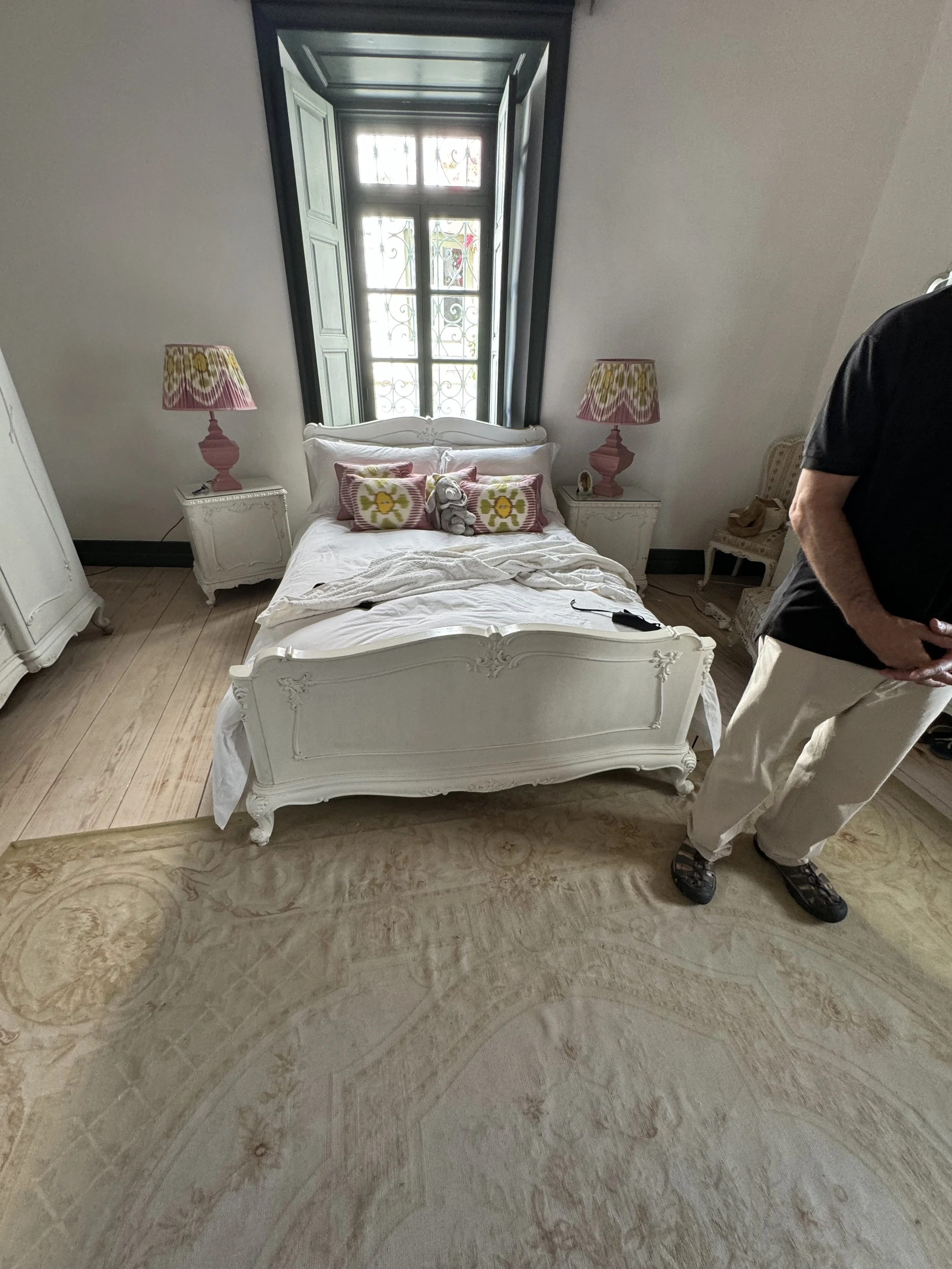
From there we entered the bedroom where Papouli’s sisters were born.
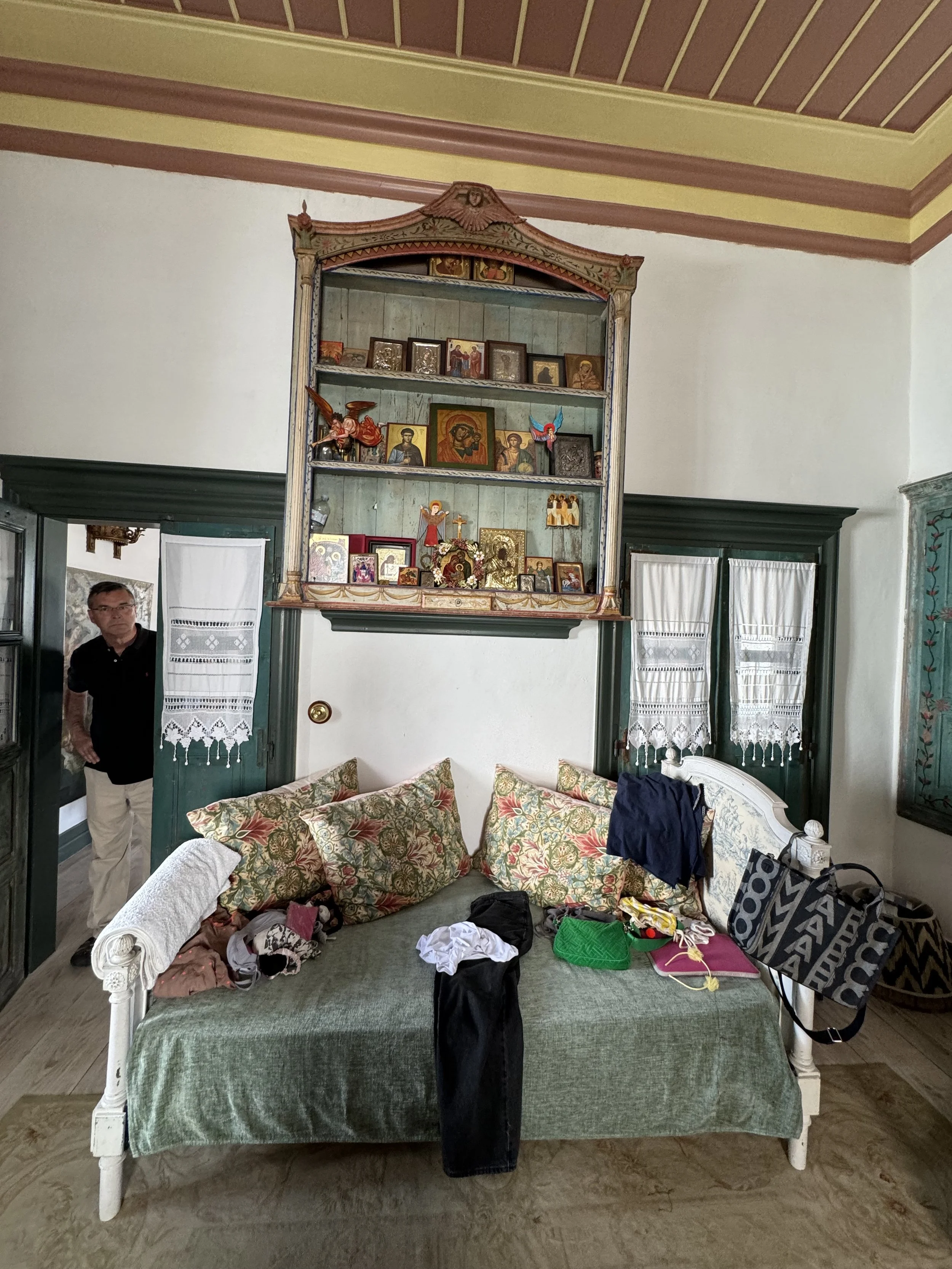
Facing the bed was a massive iconostasis. Most Orthodox Christians set up an icon station, or iconostasis, in their homes, which is a designated place for family worship, where morning and evening prayers are offered, and others as well. The one in Papouli’s family’s home is the biggest one I’ve ever seen in any home.
A Little About My Personal Faith
Speaking of Orthodox Christians, I feel compelled to give a little personal statement of my Christian faith. I have no idea who will read this blog–I’m writing mostly for Wally and me and our kids and friends who’ve said, “I want to hear all about your trip.” My friends may just be being nice. It’s hard for me to imagine too many people who would be that interested in our trip or family history–but then it fascinates me. Shouldn’t we all be fascinated by our stories?
Folks who know me know that I’m a devout follower of Jesus. Not because of anything special about me. Rather, I am convinced that God, (the Trinitarian Father, Son, and Holy Spirit), the Creator and Sustainer of all of life, exists, is holy and demands that we be holy to enter His Presence. I’m convinced that unlike Him, I am rebellious, naturally preferring my own way to His–which the Bible calls sin. And because of my sin, I justly deserve His judgment and wrath. But in His kindness, He sent His only Son, Jesus, the Messiah, who was and is fully God and fully Man, to suffer the just wrath I deserve, and to cover me with His perfect righteousness.
Because Jesus lived and died for me, I aim to live and die for Him.
I wasn’t always a follower of Jesus, though I was baptized in the Greek Orthodox Church when I was little. My parents had eloped before I was born, and on the same day my mother and I were both baptized, and my parents married in the Greek Orthodox Church.
They divorced when I was eight years old, so when I was with my dad or Greek grandparents, we went to the Greek Orthodox Church. My mom didn’t go to church, but she sent us to one down the street on Sunday mornings–I think mostly to give her some peace and quiet–much needed with three little kids as a single mom. It was Baptist, and sometimes my great-aunt would take us to her Baptist church.
When I was around four years old, Papouli showed me how Greek Orthodox make the sign of the cross. Right thumb, index, and middle finger together remind you that God is a Trinity: Father, Son, and Holy Spirit. Ring finger and pinky stick together and can never be separated because Jesus is fully God and fully man. These last two fingers are pressed into our palm to remind you that Jesus died on the cross for our sins. Always our right hand because after Jesus rose from the dead, He ascended into heaven and is seated at the right hand of God the Father.
Papouli told me as a four-year-old that Orthodox, Catholic, and Protestant–the three main branches of Christianity all hold to the truths contained in the sign of the cross.
The brokenness in our family and my own confusion about who I was and why I was here, my sense of not belonging, and my shame about never being good enough would lead me to such despondency as a teenager, that just before my 18th birthday, I decided to take my life.
At that moment, in the valley of the shadow of death, God’s light broke through. Convinced of His immense and unfailing love for me, I surrendered my life to Him and have sought to follow Him ever since.
God led me to grow in my faith through the influence of Christians from lots of different backgrounds. As a young believer, I was often tossed and confused by the winds of so many different teachings. God brought me stability through His Word, which eventually led me to the Presbyterian Church in America.
Some Protestants don’t consider Greek Orthodox or Catholics to be Christian because they have so many different beliefs and practices: priests, bishops, archbishops, icons, transubstantiation, etc.
But as Protestants, there are so many denominations with so many different beliefs and practices, and as a genuine follower of Jesus, I’ve worshiped in the extremes of both the very informal and unstructured charismatic to the highly structured and liturgical.
As a pilgrim who is pushing sixty and has been following Jesus for 40+ years, I’m convinced that we’re all on a journey–or in the words of Paul in Philippians 3, running a race. I love what he says in verses 15-16 of that chapter, “all of us who are mature should take such a view of things. And if on some point you think differently, that too God will make clear to you. Only let us live up to what we have already attained.”
So, I go back to what Papouli taught me as a little girl when he taught me the sign of the cross. It’s basically the same thing we confess when we speak the Apostles’ Creed.
In the late 90’s Wally and I listened to a Greek Orthodox priest explain about the icons in the Greek Orthodox Church. He reminded the listeners how for centuries people were illiterate. Before the printing press, few people could read. He explained that the Orthodox Church sees itself in many ways like the mother of God’s people–nurturing their faith. And like any good mother who uses pictures to teach her children, the Orthodox Church uses pictures–or icons.
He went on to point out who different people were: like Adam, Noah, Abraham, Moses, and how each one was revealing a little truth about the coming Messiah–the coming Christ–saying in essence, “the Christ is coming, the Christ is coming.” And then the icon with Mary holding Jesus in essence is her saying, “Look. The One you’ve been waiting for –the Christ–is here.”
As Wally and I listened, we were in awe as we’d both been students of covenant theology, and here we were hearing it in the Orthodox Church!
Still, we wondered about “praying to the icons” or “praying to the saints.” The priest explained that Orthodox don’t believe that when Christians depart this life that they cease to exist–rather that they are just on the other side. Therefore, as we are surrounded by such a great cloud of witnesses, we can ask them for prayer, even as we ask friends on this side who have not departed. Saints on the other side don’t have the distractions that people in this world have.
That explanation helped me understand where they’re coming from, and I share it here in hopes that any non-Catholic or non-Orthodox readers will have some understanding too. I probably ought to add, however, that because I don’t see icons being used in Scripture, and because I don’t read about praying to people who have passed from this life in the Bible, I’m personally not comfortable with it.
I probably should also acknowledge that while we were in Patmos, we visited a monastery where a nun asked if I were Orthodox. When I told her I had been baptized Orthodox as a child but now am Presbyterian, she remarked, “so you’ve renounced your faith.” And after she concluded our tour, she said she would pray for my spiritual enlightenment.
A Little More About My Family
Remember the ΓΙ above the door?
When Cookie and I talked to Melina, she told us that it was Georgos Ipokratides, (pronounced Your-ghee-oh Ee-pock-ruh-tee-deez), Yaya Calliope’s grandfather.
Immediately I remembered his name from my interview with Aunt Calliope. I had written his name down (though I misspelled it as Hippocratithes—sort of like Hippocrates) because I was so impressed that he not only spoke seven languages, but had PhDs in seven languages and was learning Mandarin when he died. Papouli had told me that detail about one of his grandfathers when I was little and my dad had repeated it, but Aunt Calliope was the one who told me which grandfather and the grandfather’s name.
I was amazed by the care and beauty Melina and Dimitri put into the restoration of Papouli’s home and asked Dimitri what kind of work he did. I was not surprised when he told me that he restores old homes. You can also see how beautifully and artfully their home is decorated. Cookie explained that Melina is an interior designer, so it all made sense!
After we left Patmos, I was thinking about them and wondered if either of them had a website. An internet search for Melina Horne yielded this interview and I discovered she is known for creating unique and luxurious home decor items. Dimitri’s site of restored homes is every bit as exquisite. But what I find most striking in the midst of such high profile people is how down to earth they both are. Both true joys to talk to.
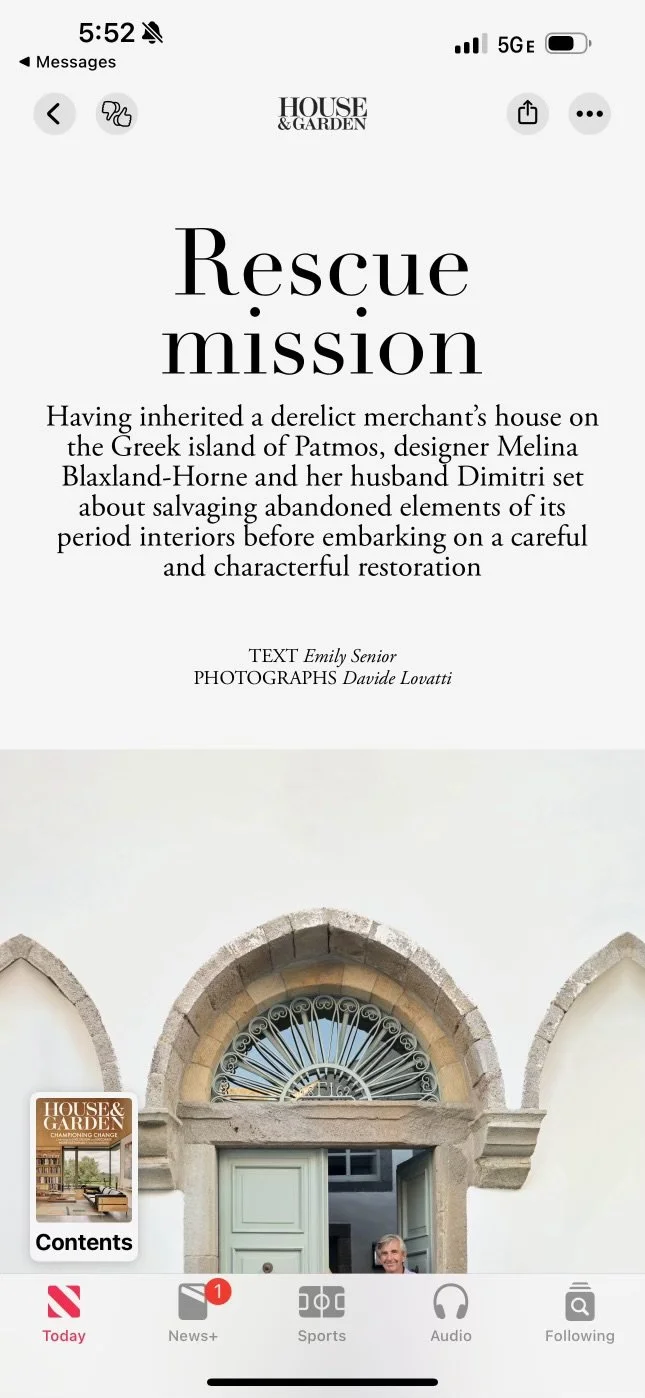
A couple of months after we got home, Melina and Dimitri’s home was featured in a House & Garden magazine.
I found myself utterly astonished that with all the billions of people on the planet, that though I am so incredibly unknown and insignificant, living in a relatively obscure place, and yet God has given me such a heritage. That my family—my grandparents and great grandparents were considered aristocracy on Patmos. Patmos. Where John received the Revelation.
Before our trip, Wally and I watched this video with Louie Giglio—if the earth were a golfball.
I found myself reflecting on how utterly microscopic I am on this tiny golfball that is the earth and that so huge from my perspective. How utterly astounding that God set His love on me. And gave me this heritage.
Regardless of what your story is, if you study your history in light of who God is and in light of eternity, you will be astonished too.
